

Table of Contents
-
Comparison: Full-Spectrum CBD and CBD Isolate at a Glance
-
Ingredients of Full-Spectrum CBD
-
Purity and Dosage of CBD Isolate
-
Entourage Effect in Full-Spectrum CBD
-
Which CBD is More Effective: Full-Spectrum CBD or CBD Isolate?
-
THC Traces in Full-Spectrum CBD
-
Taste of Full-Spectrum CBD and CBD Isolate
-
Lab Certificate for Full-Spectrum CBD and CBD Isolate
- Who is Full-Spectrum CBD the Right Choice for?
-
Who is CBD Isolate Suitable For?
-
Purchase Decision: Full-Spectrum CBD or CBD Isolate?
-
Conclusion: Full-Spectrum CBD has a Broader Effect, CBD Isolate has a More Controlled Effect
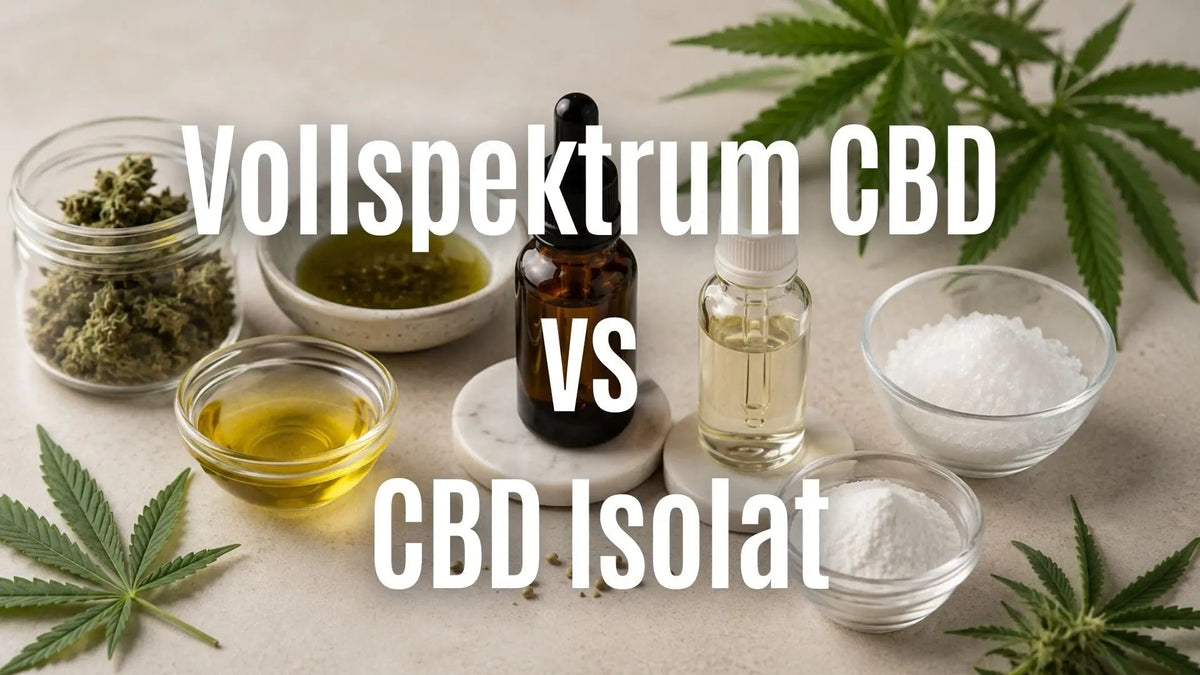
Full-spectrum CBD contains CBD plus other natural hemp components, while CBD isolate consists almost exclusively of pure cannabidiol. In addition to CBD, full-spectrum CBD also provides accompanying substances such as other cannabinoids, terpenes, and flavonoids. CBD isolate is more highly refined and generally contains no relevant amounts of other hemp components.
The most important difference, therefore, lies not in the CBD itself, but in the chemical environment of the CBD. Cannabidiol remains cannabidiol, but full-spectrum CBD comes with a plant matrix, while CBD isolate is reduced to a single active ingredient. That is why full-spectrum CBD is often described as "broader," while CBD isolate is considered particularly clear, controllable, and THC-free.
Practical recommendation: Those looking for a CBD product that is as close to the plant as possible should compare full-spectrum CBD. Those who want to avoid THC traces or prefer a very precise dosage should consider CBD isolate.


Comparison: Full-Spectrum CBD and CBD Isolate at a Glance
|
Property |
Full-Spectrum CBD |
CBD Isolate |
|
Composition |
CBD plus other hemp components |
Almost pure CBD |
|
Other Cannabinoids |
Yes, depending on the extract |
Normally no |
|
Terpenes and Flavonoids |
Yes, depending on the extract |
Normally no |
|
THC Traces |
Possible, depending on the product |
Normally not included |
|
Taste |
Often more hempy and intense |
Mostly more neutral |
|
Dosage |
Somewhat more product-dependent |
Very precisely calculable |
|
Impression of Effect |
Often broader |
Often clearer and more isolated |
|
Suitable for |
Users who want a plant-based hemp profile |
Users who want to avoid THC or dose precisely |

Ingredients of Full-Spectrum CBD
Full-spectrum CBD contains, in addition to cannabidiol, other components of the hemp plant. These can include cannabinoids such as CBG, CBC or CBN, aromatic terpenes, and plant flavonoids. The exact composition depends on the hemp variety, the extraction, and further processing.
These accompanying substances are the reason why full-spectrum CBD should not only be evaluated based on "CBD quantity." Two oils with the same CBD concentration can differ if one product contains more terpenes or additional cannabinoids. A reputable full-spectrum CBD product should therefore transparently disclose not only the CBD content but also the cannabinoid profile and the THC level.
Practical recommendation: For full-spectrum CBD, an up-to-date lab certificate should always be available, listing CBD, THC, and other cannabinoids individually.
Purity and Dosage of CBD Isolate
CBD isolate is the most highly refined form of CBD and contains almost exclusively cannabidiol. CBD isolate is often used as a crystalline powder or as a base for oils, cosmetics, and other CBD formulations. Because CBD isolate contains few accompanying substances, the amount of CBD can be particularly well standardized.
This precision is the biggest advantage of CBD isolate. For example, if a product specifies a certain amount of CBD per serving, this amount is easier to calculate for isolate products than for more complex full-spectrum extracts. CBD isolate is also usually more neutral in taste because the typical hemp notes from terpenes and plant substances are largely absent.
Practical recommendation: CBD isolate is useful when a neutral formulation, a mild taste, or a very precise CBD specification is paramount.
Entourage Effect in Full-Spectrum CBD
The entourage effect describes the idea that CBD, together with other hemp components, can act differently than CBD alone. In full-spectrum CBD, cannabidiol, other cannabinoids, terpenes, and flavonoids do not exist in isolation, but form a combined plant profile. Therefore, some users perceive full-spectrum CBD as more well-rounded or intense.
However, it is important to note: The entourage effect is not an automatic promise of quality. A full-spectrum product is only convincing if its composition is cleanly documented and the values in the lab certificate match the product. A poorly controlled full-spectrum CBD is not better than a clean CBD isolate.
Which CBD is More Effective: Full-Spectrum CBD or CBD Isolate?
Full-spectrum CBD can be more effective if "more effective" refers to a broader plant profile. CBD isolate can be more useful if "more effective" means a precise, reproducible, and THC-free application. Therefore, there is no blanket answer that is equally correct for all users.
Full-spectrum CBD brings together several hemp components and can therefore be perceived as more complete. CBD isolate, on the other hand, provides only the single component CBD and reduces variables such as THC traces, terpenes, or other cannabinoids. The more effective choice therefore depends on the goal: plant profile or control.
Practical recommendation: For the broadest possible hemp profile, full-spectrum CBD is usually the more suitable choice. For THC avoidance, neutral formulations, and exact standardization, CBD isolate is usually the more suitable choice.

THC Traces in Full-Spectrum CBD
Full-spectrum CBD can contain traces of THC because full-spectrum extracts retain as many natural components of the hemp plant as possible. These traces should be within the applicable legal limits, but must be clearly verifiable in the lab certificate. Users who want to completely avoid THC should therefore examine full-spectrum CBD particularly carefully.
CBD isolate is simpler in this regard. Since CBD isolate consists almost entirely of cannabidiol, CBD isolate usually contains no relevant amounts of THC. Nevertheless, a lab certificate should also be available for CBD isolate, because contamination or production errors can never be excluded by marketing statements alone.
Practical recommendation: Anyone who needs to avoid THC for professional, athletic, or personal reasons should prefer CBD isolate or a product proven to be THC-free.
Taste of Full-Spectrum CBD and CBD Isolate
Full-spectrum CBD often tastes more hempy because terpenes and plant substances are retained in the extract. This taste can be earthy, herbaceous, or slightly bitter. For users who like the natural hemp character, this is an advantage.
CBD isolate usually tastes more neutral because the aromatic accompanying substances have been largely removed. Therefore, CBD isolate is well suited for products where the inherent taste should remain as minimal as possible. This can be relevant for cosmetics, formulations with flavor, or particularly mild oils.
Practical recommendation: Those who want a natural hemp taste tend to choose full-spectrum CBD. Those who prefer a more neutral taste tend to choose CBD isolate.
Lab Certificate for Full-Spectrum CBD and CBD Isolate
A lab certificate is more important for full-spectrum CBD and CBD isolate than the product name. Terms like "full-spectrum," "premium," or "pure" are only meaningful if independent analysis values confirm the claims. A good certificate shows what is actually in the product.
For full-spectrum CBD, the lab certificate should at least list CBD, THC, and other cannabinoids. For CBD isolate, the lab certificate should show that the CBD content matches the declaration and that no relevant amounts of THC are present. In addition, tests for heavy metals, pesticides, solvent residues, and microbiological contamination are useful.
Practical recommendation: A CBD product without an up-to-date lab certificate should not be the first choice, regardless of whether it is full-spectrum CBD or CBD isolate.
Who is Full-Spectrum CBD the Right Choice for?
Full-spectrum CBD is suitable for users looking for a hemp profile that is as close to the plant as possible. These users do not just want isolated CBD, but also want to consider the accompanying components of the hemp plant. Full-spectrum CBD is therefore particularly interesting when the natural composition of the hemp extract is an important purchasing criterion.
Full-spectrum CBD is less suitable for people who must consistently avoid THC traces. Also, users who prefer a very neutral taste sometimes find full-spectrum CBD too intense. In these cases, CBD isolate or another THC-free product may be a better fit.
Practical recommendation: Full-spectrum CBD is the right direction if naturalness, hemp profile, and accompanying substances are more important than maximum neutrality.


Who is CBD Isolate Suitable For?
CBD isolate is suitable for users who want to use CBD as controllably as possible and without other hemp components. CBD isolate is particularly interesting when THC-freedom, precise dosage, or a neutral taste are important. CBD isolate is also an obvious choice for formulations where the hemp taste should not dominate.
CBD isolate is less suitable for users who consciously seek the full plant profile of the hemp plant. Those who want terpenes, flavonoids, and other cannabinoids as part of the product experience will probably be less satisfied with a pure isolate. CBD isolate is clearer but less complex.

Purchase Decision: Full-Spectrum CBD or CBD Isolate?
The best CBD form depends on the desired product profile. Full-spectrum CBD is usually the better choice for users looking for a natural hemp profile with multiple plant compounds. CBD isolate is usually the better choice for users who want to avoid THC, dose precisely, or prefer a more neutral taste.
A simple decision-making aid is this question: Should the product contain as many hemp components as possible or be reduced to CBD as clearly as possible? If the answer is "as many hemp components as possible," full-spectrum CBD is a better fit. If the answer is "as pure CBD as possible," CBD isolate is a better fit.
Conclusion: Full-Spectrum CBD has a Broader Effect, CBD Isolate has a More Controlled Effect
Full-spectrum CBD and CBD isolate are not better or worse versions of each other, but two different CBD profiles. Full-spectrum CBD contains CBD along with other hemp components and can therefore be perceived as broader. CBD isolate contains almost only cannabidiol and thus offers more control, neutrality, and THC avoidance.
Those looking for a plant-based hemp product often make the more suitable choice with full-spectrum CBD. Those looking for a CBD product that is as pure, neutral, and precisely dosable as possible often make the more suitable choice with CBD isolate. In both cases: An up-to-date lab certificate is more important than any marketing promise.
Official sources for the article
-
EFSA – Provisional safe level for cannabidiol as a novel food
https://www.efsa.europa.eu/en/news/provisional-safe-level-cannabidiol-novel-food -
EU Law – Regulation (EU) 2015/2283 on novel foods
https://data.europa.eu/eli/reg/2015/2283/oj -
WHO – Cannabidiol (CBD) Critical Review Report
https://www.who.int/docs/default-source/controlled-substances/whocbdreportmay2018-2.pdf -
FDA – Products Containing Cannabis or Cannabis-derived Compounds, Including CBD
https://www.fda.gov/consumers/consumer-updates/what-you-need-know-and-what-were-working-find-out-about-products-containing-cannabis-or-cannabis