
CBD vapes enable the absorption of cannabidiol through the lungs. As a result, CBD enters the bloodstream more rapidly than through ingested capsules or swallowed CBD oil. However, how noticeably a CBD vape performs depends on the CBD dosage, liquid formulation, heating hardware, inhalation technique, and individual biological factors.
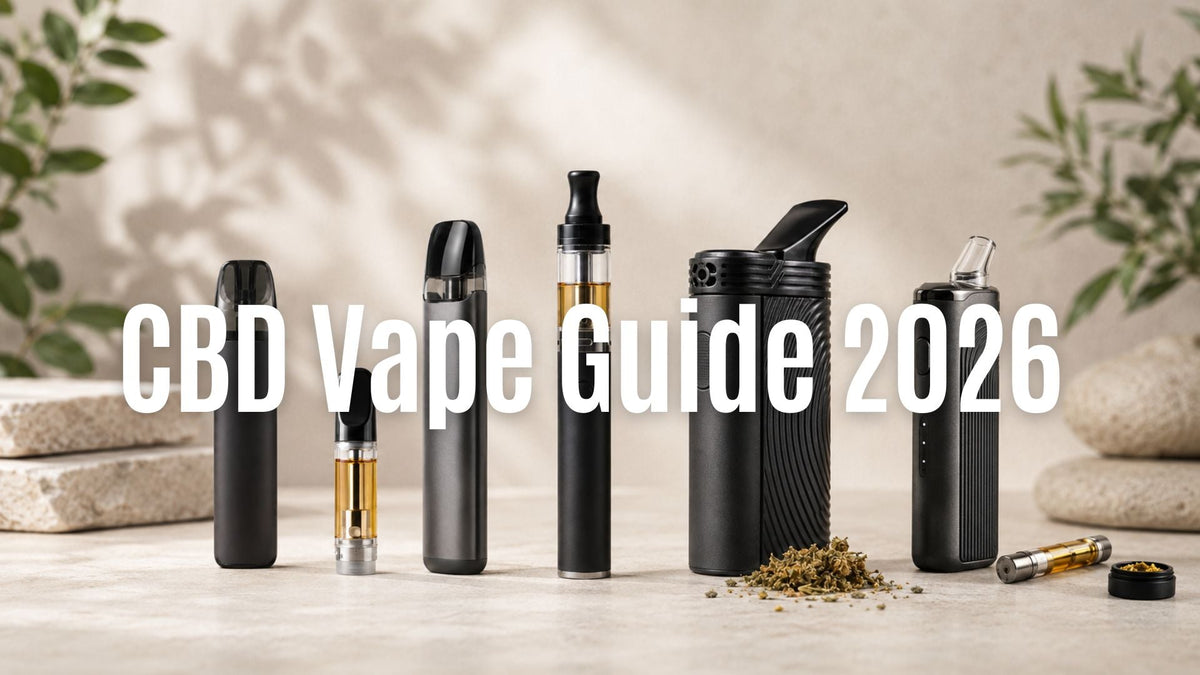
At the same time, the market is diverse: products range from simple disposable e-cigarettes and refillable pod systems to dedicated dry herb vaporizers designed for CBD flowers. In this comprehensive CBD Vape Guide 2026, we explore how CBD vapes work, their advantages and limitations, how to calculate intake per puff, key quality indicators, and what German legal regulations apply.
Table of Contents
- What Is a CBD Vape?
- What Types of CBD Vapes Are Available?
- How Does a CBD Vape Work in the Body?
- What Are the Real Benefits of Vaping CBD?
- How Fast Does a CBD Vape Take Effect?
- What Is a Dry Herb Vaporizer?
- How Does a Dry Herb Vaporizer Work?
- What Are the Advantages of a Dry Herb Vaporizer?
- CBD Liquid Vape vs. Dry Herb Vaporizer?
- Which CBD Vape Is Best in 2026?
- How Much CBD Is in One Puff?
- How to Recognize a High-Quality CBD Vape
- CBD Vape, Dry Herb Vaporizer, or CBD Oil?
- What Is the Legal Status in Germany?
- Conclusion: The Best CBD Vape Convinces Through Transparency

What Is a CBD Vape?
A CBD vape is an electronic device that gently heats a CBD-containing product to generate an inhalable aerosol. The vapor is inhaled through a mouthpiece.
A standard CBD vape typically comprises three core components: an electrical power source (battery/mod), a heating element (atomizer coil or ceramic chamber), and a reservoir containing the CBD preparation (prefilled cartridge, pod, or refillable tank).
In practice, a fundamental distinction exists between devices that vaporize a formulated CBD liquid (e-liquid) and dry herb vaporizers designed to heat unprocessed, cured CBD hemp flowers without combustion.
CBD vapes must not be confused with cannabis smoking. While smoking burns plant matter at temperatures exceeding 600 °C—producing harmful tar and combustion toxins—vaporizers heat the substance in a controlled temperature band (usually between 160 °C and 220 °C) to release cannabinoids and volatile terpenes without burning.
What Types of CBD Vapes Are Available?
Vape Type |
Operating Logic |
Advantages |
Disadvantages |
Disposable CBD Vape |
Prefilled, integrated battery, single-use device |
Ready to use immediately, no maintenance |
Electronic waste, non-rechargeable battery, higher long-term cost |
Pod System |
Rechargeable battery with prefilled or refillable pods |
Compact, reusable battery, easy pod replacement |
Often brand-proprietary pods, recurring cartridge costs |
510-Thread Cartridge |
Standardized glass cartridge screwed onto a 510 battery |
Universal battery compatibility, wide variety of extract profiles |
Cartridge must be replaced when depleted, delicate glass body |
Refillable Box Mod |
Refillable tank paired with adjustable wattage battery mod |
High flexibility in liquid choice, cost-effective per ml |
Requires coil maintenance, refilling, and technical familiarity |
How Does a CBD Vape Work in the Body?
When vaping CBD, cannabidiol is absorbed via the respiratory tract into the pulmonary alveoli and enters the bloodstream directly. This process bypasses the gastrointestinal tract and liver first-pass metabolism entirely.
Consequently, pulmonary inhalation exhibits significantly higher bioavailability compared to oral ingestion. Scientific studies indicate that pulmonary inhalation of cannabinoids typically achieves systemic bioavailability ranging between 20% and 40%, whereas oral ingestion via digestion often yields between 6% and 15%.
Once in the bloodstream, CBD interacts with the body's endocannabinoid system (ECS), indirectly modulating CB1 and CB2 receptor pathways, serotonin receptors (5-HT1A), and transient receptor potential (TRPV) channels. CBD is non-intoxicating and does not trigger the typical euphoric high associated with THC.
What Are the Real Benefits of Vaping CBD?
The most prominent practical benefit of a CBD vape is its rapid onset and convenience. The device is instantly available on demand and allows step-by-step titration puff by puff.
Users frequently appreciate CBD vapes in high-stress moments, when experiencing restlessness, or as an evening relaxation ritual. The immediate availability allows users to calibrate their intake in real time, avoiding the multi-hour delays typical of swallowed capsules or edibles.
The Clinical Research Transfer Check
While laboratory and clinical studies have validated high-dose pharmaceutical cannabidiol in specific rare forms of epilepsy, consumer CBD vapes operate in a different context. A commercially available CBD vape is a wellness product, not a certified medication. Commercial products must not make health claims or promise therapeutic cures regarding anxiety disorders, clinical depression, insomnia, or severe pain.
How Fast Does a CBD Vape Take Effect?
Inhaled vapor is absorbed within minutes. While marketing claims sometimes promise an “effect in seven seconds,” physiological response varies depending on inhalation depth, breath-holding duration, device temperature, and individual metabolism.
Most consumers notice subjective sensations within 2 to 10 minutes after inhalation. The duration of observable effects is correspondingly shorter than with oral oils, typically peaking around 30 to 45 minutes and gradually tapering over 2 to 3 hours.

What Is a Dry Herb Vaporizer?
A dry herb vaporizer is a device specifically engineered to heat dried, raw botanical material rather than liquid solutions. In a CBD dry herb vaporizer, cured CBD flowers are loaded directly into an oven chamber and brought to vaporization temperature under precise electronic control.
The heating process releases natural cannabinoids and volatile terpenes into a clean aromatic vapor without causing combustion, ash, or toxic smoke.
How Does a Dry Herb Vaporizer Work?
Depending on heating technology, dry herb vaporizers operate via conduction, convection, or a hybrid combination:
Conduction Vaporizers
In conduction devices, the ground botanical material is placed in direct contact with the heated walls of the oven chamber (usually ceramic, stainless steel, or aluminum). Conduction allows fast heating times and compact form factors, though periodic stirring may be required for uniform extraction.
Convection Vaporizers
In convection vaporizers, heated air is drawn through the herbal chamber during inhalation. The hot airstream extracts volatile compounds evenly without direct contact with a hot surface, providing exceptional flavor fidelity and uniform material utilization.
What Are the Advantages of a Dry Herb Vaporizer?
The primary advantage of a dry herb vaporizer is the direct utilization of natural, whole-plant CBD flowers without additives or carrier liquids.
1. No Liquid Carrier Bases
Dry herb vaporizers eliminate the need for vegetable glycerin (VG), propylene glycol (PG), or synthetic flavorings. You vaporize 100% natural, unadulterated botanical plant material.
2. Observable Botanical Quality
Unlike sealed liquids where origin cannot be visually assessed, dry flowers allow users to directly inspect bud structure, trichome coverage, aroma, and cure.
3. Durable Hardware
A high-quality dry herb vaporizer is a durable, rechargeable investment that minimizes disposable electronic waste.
4. Precision Temperature Control
Digital temperature control allows users to dial in specific vaporization points: lower temperatures (160–185 °C) emphasize light terpenes like pinene and myrcene, while higher settings (190–210 °C) maximize fuller cannabinoid extraction.
5. Clean Vapor Over Smoke
Eliminates harmful tar, carbon monoxide, and harsh carcinogens associated with joint smoking or pipe combustion.
CBD Liquid Vape vs. Dry Herb Vaporizer?
Feature |
CBD Liquid / Cartridge Vape |
Dry Herb Vaporizer (Flowers) |
Consumable Material |
CBD E-Liquid / Distillate in PG/VG or Terpenes |
Ground, dried CBD hemp flowers |
Ease of Handling |
Very simple, ready instantly without prep |
Requires grinding, chamber loading, and cleaning |
Smell & Discretion |
Discreet, mild vapor scent that dissipates fast |
Authentic herbal scent, more noticeable during use |
Ingredient Purity |
Depends heavily on carrier liquid quality |
100% natural plant matter, zero carriers |
Hardware Investment |
Low initial cost (batteries from €10–€30) |
Higher initial investment (€70–€250+) |
Which CBD Vape Is Best in 2026?
The optimal device in 2026 depends entirely on your usage priorities:
Best System for Beginners
Prefilled cartridges with a universal 510 battery or closed pod systems offer the smoothest learning curve. Look for verified ceramic heating coils and comprehensive lab certificates.
Best System for Regular Consumers
A rechargeable pod system with refillable pods or a quality 510 variable voltage battery balances convenience, cost efficiency, and performance.
Best System for Flower Connoisseurs
A dedicated portable convection or hybrid dry herb vaporizer allows you to experience the full spectrum of cannabinoids and natural terpenes with zero carrier additives.
Best System for Pure Extracts Without Carriers
Broad-spectrum or full-spectrum 510 distillate cartridges that formulate purely with cannabis-derived terpenes—completely free of PG, VG, or MCT oils.
How Much CBD Is in One Puff?
Cannabidiol quantity per inhalation can only be estimated arithmetically, as draw length, breath force, and temperature vary per puff.
Calculating for a CBD Liquid Vape
Formula: Total CBD (mg) ÷ Total estimated puffs = Estimated CBD per puff (mg)
Example: A 1 ml cartridge containing 500 mg CBD rated for approximately 250 puffs yields roughly 2 mg of CBD per 2-second draw.
Calculating for a Dry Herb Vaporizer
Formula: Chamber weight (g) × CBD percentage × Extraction efficiency ≈ Released CBD
Example: 0.15 g of CBD flower with 10% CBD contains 15 mg of CBD. Assuming roughly 60% vaporization efficiency, around 9 mg of CBD will be vaporized across a 5–10 draw session.

How to Recognize a High-Quality CBD Vape
Quality must be inspected on two fronts: the consumable formulation and the device hardware.
Quality Check for CBD Liquids & Cartridges
- Total CBD content stated clearly in milligrams (mg), not just ambiguous percentages.
- Independent laboratory certificate verifying cannabinoid profile, THC threshold (< 0.2%), and absence of heavy metals.
- Purity: Zero Vitamin E acetate, zero diacetyl, zero synthetic cannabinoids, and zero harmful cutting agents.
- Ceramic atomizer core and medical-grade glass housing to avoid heavy metal leaching.
Quality Check for CBD Flowers (Dry Herb)
- Sourced from certified EU industrial hemp varieties.
- Properly cured with water activity between 0.55 and 0.65; free of mold, seeds, and stem debris.
- Lab-tested THC content strictly compliant with statutory limits.
CBD Vape, Dry Herb Vaporizer, or CBD Oil?
Criterion |
CBD Liquid Vape |
Dry Herb Vaporizer |
Sublingual CBD Oil |
Onset Time |
1–5 minutes |
2–10 minutes |
15–45 minutes |
Duration |
1–3 hours |
2–4 hours |
4–6 hours |
Bioavailability |
High (approx. 20–40%) |
High (approx. 25–40%) |
Moderate (approx. 12–20%) |
Preparation |
None required |
Grinding and chamber loading |
Drops under the tongue |
What Is the Legal Status in Germany?
The label “CBD” is not a blanket legal exemption. In Germany, specific legal frameworks govern CBD depending on product classification:
For raw botanical material (CBD flowers), commercial sales to end consumers require strict compliance with industrial hemp provisions under the German Cannabis Act (KCanG). Products must be derived from certified EU hemp seed catalogs, maintain THC levels below statutory limits (max 0.2% / 0.3%), and ensure misuse for intoxication purposes is excluded. Commercial flower products at CANNANA are sold strictly as botanical specimens and raw materials, not for smoking or ingestion.
Vape liquids and electronic hardware must comply with tobacco and vaping product regulations (Tabakerzeugnisgesetz), consumer safety standards, electrical safety directives (CE, RoHS), and child-resistant packaging requirements.
Fazit: The Best CBD Vape Convinces Through Transparency
The best CBD vape in 2026 is not a one-size-fits-all device. Your optimal choice depends on whether you seek rapid on-the-go discretion, recyclable hardware, unadulterated whole-plant flowers, or pure terpene distillates.
Irrespective of whether you choose an ergonomic 510 cartridge or a sophisticated dry herb vaporizer, quality always starts with what is inside: transparent origin, verified cannabinoid profiles, clean heating materials, and accredited third-party lab testing.
Discover curated CBD and Cannabis Vapes at CANNANA and compare cannabinoid profiles, hardware types, capacities, and verified laboratory reports.
Sources and References
3
Scientific references, official statements, and legal frameworks for this article:
-
WHO: Cannabidiol (CBD) Critical Review Report Official Authority
Frequently Asked Questions (FAQ)
What is the difference between a CBD vape and a dry herb vaporizer?
Does a CBD vape get you high?
Can you put CBD e-liquid into a dry herb vaporizer?
This article is provided for general informational purposes only and does not constitute legal, tax or medical advice. For individual questions, please consult a qualified professional. Laws and regulations may change – please always check the currently applicable legal requirements.