
Content
- High-CBD hemp flowers are only useful if the CBD content is verifiable
- CBD content in percentage indicates how much CBD is arithmetically contained in one gram of flowers
- Laboratory analyses are more important than strain names and marketing terms
- Very high CBD values should be transparently explained
- Natural CBD flowers and CBD-boosted flowers meet different expectations
- Indoor, greenhouse, and outdoor CBD flowers differ mainly in control and aroma
- THC values and legal product information must be clearly recognizable
- CBD flowers should not be sold with health claims
- Freshness and storage influence the quality of CBD flowers
- Where can you find CBD flowers with particularly high CBD content?
- Buy CBD flowers with high CBD content in our shop
- Conclusion: High CBD content is only one quality feature

High-CBD hemp flowers are only useful if the CBD content is verifiable
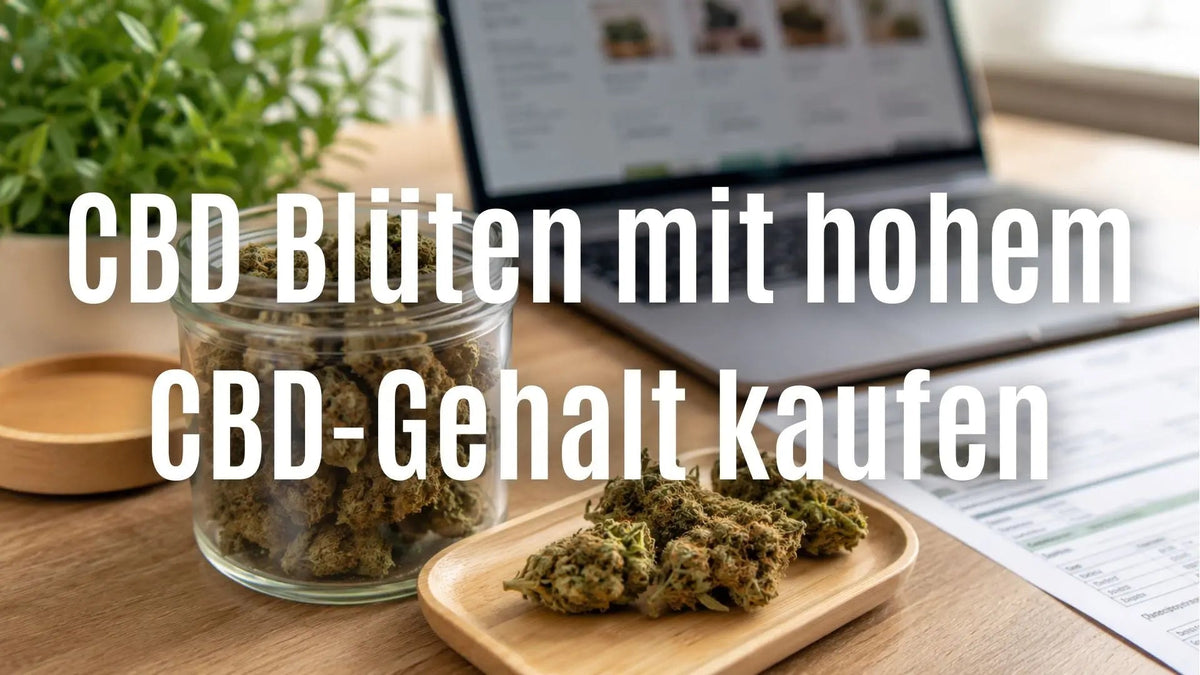
You can find high-CBD hemp flowers not only through large percentages on a product page, but also through verifiable lab results, clear product information, and transparent origin. A high CBD value alone does not tell you whether a flower is high-quality, fresh, or suitable for your purpose. It is crucial whether the shop clearly discloses the CBD content, THC value, batch, and product type.
A good comparison therefore does not begin with the question "Which CBD flower has the highest CBD value?", but with the question: "Can I verify the stated CBD value?" Especially with products claiming very high values like 30%, 40% or more, you should check carefully whether they are naturally grown CBD flowers or enhanced flowers enriched with CBD isolate.


CBD content in percentage indicates how much CBD is arithmetically contained in one gram of flowers
A CBD content of 10% arithmetically means about 100 mg of CBD per gram of flowers, 20% corresponds to about 200 mg of CBD per gram, and 40% to about 400 mg of CBD per gram. This conversion makes product information easier to compare, as percentage values alone often seem abstract.
Example: If a CBD flower is stated to have 18% CBD, one gram of this flower arithmetically contains about 180 mg of CBD. If another CBD flower is stated to have 42% CBD, the arithmetic value is about 420 mg of CBD per gram. However, this comparison is only useful if both values come from current laboratory analyses and the product types are comparable.
Practical Recommendation: Do not compare CBD flowers solely by the highest percentage. Always check if the shop explains whether the CBD content is naturally derived from the flower or has been increased through additional processing, coating, or CBD isolate.

Laboratory analyses are more important than strain names and marketing terms
A CBD flower with a high CBD content should always be comparable with a current laboratory analysis or a certificate of analysis. The laboratory analysis should at least include the CBD or CBDa value, the THC value, the batch number, and the test date. Even better is an analysis that also considers residues such as pesticides, heavy metals, mold, or microbiological contamination.
Strain names like "Haze," "Kush," "Amnesia," or "Lemon" alone do not reliably indicate the actual CBD content. Two products with similar names can have different cannabinoid values, different terpene profiles, and different lab results. Therefore, batch analysis is the most important proof of quality.
Practical Recommendation: Prefer to buy high-CBD hemp flowers where the laboratory analysis is not hidden. A reputable product description doesn't just say "strong" or "premium," but explains which CBD value was measured, what the THC value is, and how current the analysis is.
Very high CBD values should be transparently explained
CBD flowers with extremely high CBD content should be examined particularly carefully, because values above 35% often cannot be explained solely by naturally grown flowers. For very high CBD claims, the shop should clearly state whether the flowers have been additionally enhanced with CBD isolate, resins, or other CBD-rich components.
This is not automatically negative. Enhanced CBD flowers can be interesting for buyers who are specifically looking for particularly high CBD values. It only becomes problematic when a shop quotes very high values but does not explain how these values are achieved. Transparency is therefore more important than the highest percentage.
Practical Recommendation: If you are comparing CBD flowers with 40% CBD or more, read the product description particularly carefully. Good product pages explain whether they are classic CBD flowers, CBD-boosted flowers, Moon Rocks, Ice Rocks, or flowers enhanced with CBD isolate.
Natural CBD flowers and CBD-boosted flowers meet different expectations
Natural CBD flowers are primarily of interest to buyers who value aroma, terpenes, flower structure, and a product that is as unaltered as possible. CBD-boosted flowers, on the other hand, are optimized for particularly high CBD values and can achieve significantly higher percentage figures through additional processing.
The difference is important because the two product types are not directly comparable. A natural CBD flower with 8–15% CBD can be very high quality, even if an enhanced flower with 40% CBD appears stronger on paper. The higher value does not automatically mean better quality, but initially only a higher CBD concentration.
Practical Recommendation: Before purchasing, decide what is more important to you: a natural aroma profile or a particularly high CBD content. The best CBD flower is not always the flower with the highest number, but the flower whose product specifications best match your expectations.

Indoor, greenhouse, and outdoor CBD flowers differ mainly in control and aroma
Indoor CBD flowers are grown under more controlled conditions, while greenhouse and outdoor CBD flowers are more dependent on climate, season, and natural light. Indoor cultivation can create more consistent conditions for growth, drying, and flower structure. Outdoor cultivation, on the other hand, can be more attractively priced and offer a natural aroma profile.
For a high CBD content, the cultivation method is not the only factor. Genetics, harvest time, drying, storage, and laboratory testing are at least as important. An indoor label does not replace an analysis, and an outdoor flower is not automatically inferior.
Practical Recommendation: Use the cultivation method as additional information, but not as the main criterion. If you are looking for CBD flowers with a particularly high CBD content, the laboratory analysis should always be given more weight than terms like Indoor, Greenhouse, or Premium.
THC values and legal product information must be clearly recognizable
CBD flowers with a high CBD content should always also show a verifiable THC value. For buyers in Germany, not only the CBD value is relevant, but also the legal classification of the product. According to the Cannabis Consumption Act, a distinction is made between cannabis, CBD, industrial hemp, and other categories. Industrial hemp is legally subject to certain requirements, including origin, purpose, and THC limits. [1]
Furthermore, CBD products may not generally be presented as food, food supplements, or medicines. The competent authorities point out that CBD-containing products may be subject to special requirements depending on the product category. [2]
CBD flowers should not be sold with health claims
CBD flowers with high CBD content should not be advertised with promises like "heals pain," "works against anxiety," or "treats sleep problems." Such statements can be legally problematic and are not proof of quality for buyers. A reputable shop explains product features such as CBD content, THC value, aroma, origin, laboratory testing, and storage, without promising medical effects.
This is also an important signal for buyers. Those who inform seriously separate product data from health claims. Especially with CBD flowers with very high CBD content, a sober description is better than exaggerated advertising.
Practical Recommendation: Prefer shops that describe CBD flowers factually. Good content answers questions about analysis, quality, origin, and product type. Poor content replaces data with grand promises.

Freshness and storage influence the quality of CBD flowers
High-CBD hemp flowers should be stored fresh, cleanly packaged, and protected from light, air, heat, and moisture. Poor storage can degrade the aroma, structure, and overall impression of the flowers. A high CBD value on paper is of little help if the flowers are dry, brittle, musty, or improperly stored.
A good shop therefore not only provides information about the CBD value, but also about packaging, batch, harvest or filling date, and storage instructions. Especially for premium flowers, the packaging should be airtight and light-protected.
Where can you find CBD flowers with particularly high CBD content?
You can find CBD flowers with a particularly high CBD content in shops that not only claim high CBD values but also demonstrably prove them. The most important criteria are a current laboratory analysis, a clear THC value, a clear explanation of the product type, transparent origin, and factual product communication.
When comparing several shops, you should not just choose the strongest strain. Create a short checklist:
- Is the CBD value stated per product or batch?
- Is there a current laboratory analysis?
- Is the THC value clearly recognizable?
- Is it explained whether the flower is natural or enhanced?
- Is there information about origin, cultivation method, and storage?
- Are medical promises avoided?
- Is the product category legally described?
Our quality advantage lies precisely in this transparency: high-CBD hemp flowers should not convince through loud promises, but through verifiable information. Those who are looking for high CBD values should not blindly follow the highest number, but combine the number with laboratory values, product type, and legal classification.
Buy CBD flowers with high CBD content in our shop
In our shop, you will find CBD flowers selected according to verifiable criteria: CBD content, product quality, origin, aroma, freshness, and transparent information on the product type. Our goal is not simply to show the highest percentage, but to enable you to make a clear purchasing decision.
If you want to buy high-CBD hemp flowers, pay attention to the product description, the stated CBD value, the THC note, and the information on the flower type in our range. This way, you can more quickly identify which CBD flowers match your expectations.
Practical Recommendation: Start with a CBD flower whose product information is complete and understandable. If you want to compare different CBD flowers, use CBD content, aroma, cultivation method, and product type as decision criteria.
Conclusion: High CBD content is only one quality feature
You can most reliably find CBD flowers with high CBD content by evaluating percentages, laboratory analyses, THC values, and product transparency together. A high CBD value is an important selection criterion, but it is not a substitute for certificates of analysis, clear labeling, and verifiable origin.
The best choice is a CBD flower whose CBD content is proven, whose THC value is clearly stated, and whose product description honestly explains whether it is natural or enhanced. This way, you can recognize not only potent CBD flowers but also reputable shops.
Note: This article serves for general information and does not replace legal advice. Please observe the applicable legal regulations and the specific product category.
Official sources for the footnotes in the article
- [1] KCanG / Laws on the Internet: The Cannabis Consumption Act defines "Cannabis" and excludes, among other things, CBD and industrial hemp from this definition; industrial hemp is subject to specific legal requirements, including certified varieties and a THC content of no more than 0.2% in the relevant context of use.
- [2] BVL on CBD-containing products: The Federal Office of Consumer Protection and Food Safety points out that for CBD-containing products, an approval as a medicinal product or as a novel food may be relevant before being placed on the market, depending on the product category; the BVL is also not aware of any circumstances under which cannabidiol would be marketable in food or food supplements.