
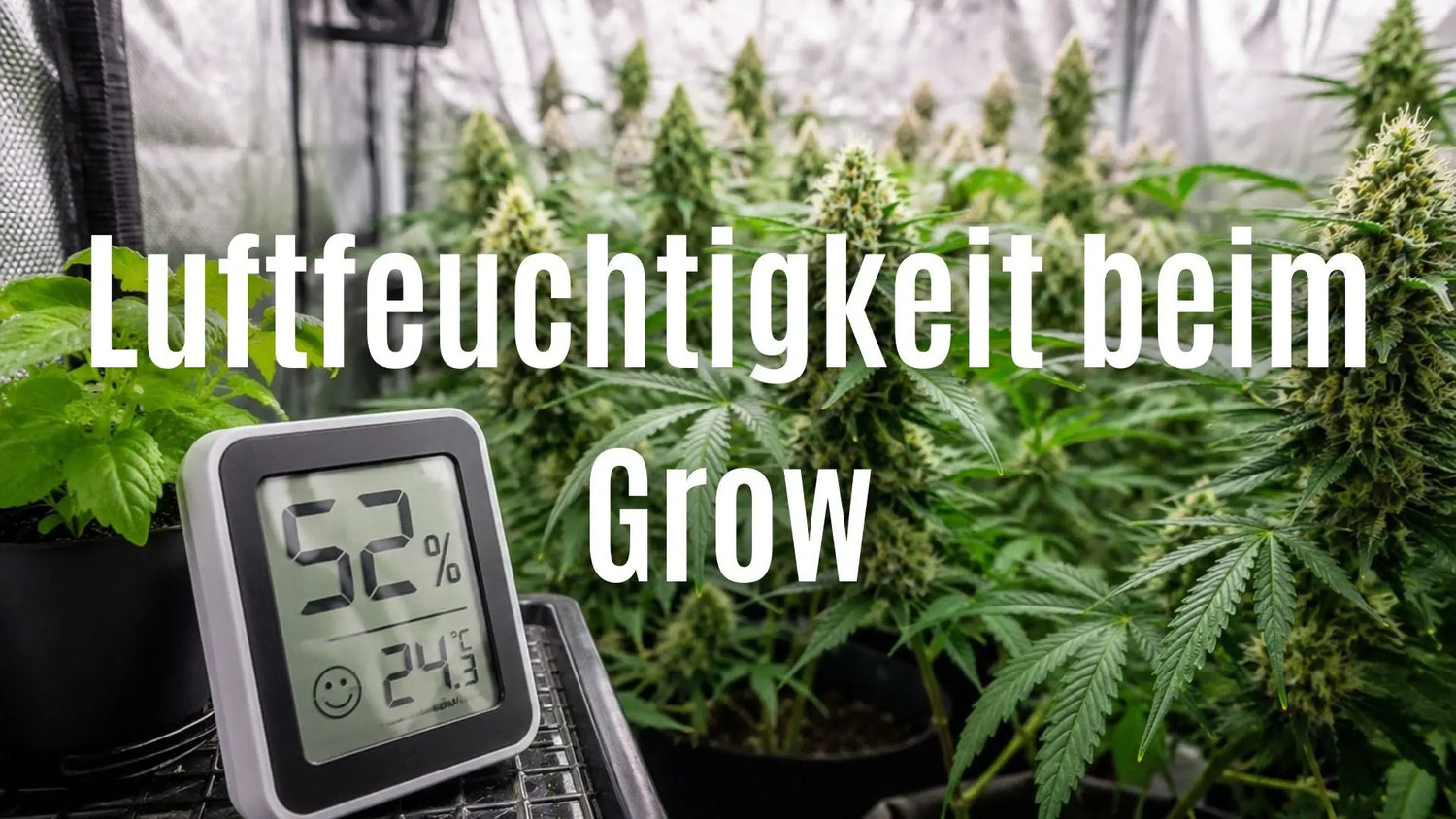

High humidity is one of the most common reasons for mold during a grow. Especially in the flowering phase, a humid climate can quickly become problematic: the buds become denser, air circulation between the flowers decreases, and small damp spots often go unnoticed for a long time.
In this CANNANA guide, you will learn what humidity levels are appropriate for each grow phase, how to detect mold early, and what measures truly help to keep your climate stable.
Note: This article is intended for adults and refers to legal home cultivation within the framework of applicable legal regulations.
Table of Contents
- Why Humidity is So Important for Growing
- Optimal Humidity for Each Grow Phase
- Why Mold Occurs During Growing
- The Greatest Danger: Mold in the Flowering Phase
- How to Measure Humidity Correctly
- Why Humidity Often Rises at Night
- How to Prevent Mold During Growing
- What to Do if Humidity is Too High?
- What to Do if You Discover Mold?
- Indoor vs. Outdoor: Where is the Risk Higher?
- Checklist: Preventing Mold During Growing
- Conclusion: Control is the Best Protection Against Mold

Why Humidity is So Important for Growing
Cannabis plants release water into the air through their leaves. This process affects the plant's growth, nutrient uptake, and temperature regulation. If the air is too dry, the plant can react with stress. If it is consistently too humid, the risk of mold, mildew, and botrytis increases.
The late flowering phase is particularly critical. During this phase, the flowers become more compact. Moisture can collect there, even while the external plant still appears healthy. Therefore, a controlled climate is one of the most important factors for a successful grow.


Optimal Humidity for Each Grow Phase
The perfect humidity depends on the phase your plant is in. Young plants prefer higher humidity, while flowering plants need a drier climate.
|
Grow Phase |
Recommended Humidity |
Goal |
|
Germination / Seedling |
approx. 65–75 % |
Protect young plants from drying out |
|
Vegetative Phase |
approx. 50–65 % |
Healthy growth and good transpiration |
|
Early Flowering |
approx. 45–55 % |
Support flower development, reduce risk |
|
Late Flowering |
approx. 40–50 % |
Prevent mold in dense buds |
|
Drying |
approx. 50–60 % |
Dry slowly, but avoid mold |
CANNANA Tip: In the flowering phase, it's better to be a bit cautious. As the buds get denser, the humidity should not consistently exceed 50–55 %.
Why Mold Occurs During Growing
Mold primarily needs three things: moisture, little air movement, and organic material. During a grow, all three factors can quickly become present if the climate is not controlled.
Typical causes include:
- too high humidity in the grow box
- insufficient exhaust air
- stagnant air between plants
- too many plants in a confined space
- damp leaves or buds
- watering shortly before the dark phase
- strong humidity fluctuations at night
- condensation on tent walls or equipment
A single high reading is not automatically a problem. It becomes dangerous if the humidity remains too high for hours or days.

The Greatest Danger: Mold in the Flowering Phase
The risk significantly increases in the flowering phase. The reason: the flowers become denser and store more moisture. While the surface may appear dry, a humid microclimate can already form inside the buds.
Botrytis, often called bud rot or gray mold, is particularly dangerous. This mold can develop inside the flower and is often only visible late.
In the flowering phase, pay particular attention to:
- musty or moldy smell
- gray, white, or brownish spots
- individual sugar leaves suddenly turning brown
- soft or damp spots in the bud
- flowers that appear unusually compact or clumpy
- condensation in the grow box
If you are unsure, carefully inspect suspicious buds. Do not shake them, do not blow on them vigorously, and do not unnecessarily touch affected areas.
How to Measure Humidity Correctly
A hygrometer is essential. Without measurement, humidity remains a mere guess – and that often leads to problems.
The correct position is important:
- measure at the height of the plant tips or buds
- do not place directly under the lamp
- do not measure directly in the strongest airflow
- do not measure only at the bottom
- use multiple sensors for larger setups
A hygrometer with a min/max function is particularly helpful. This way, you can detect if the humidity increases significantly at night. Many problems do not arise during the day but in the dark phase.

Why Humidity Often Rises at Night
When the lights go out, the temperature drops. Colder air can absorb less moisture. As a result, the relative humidity automatically increases.
This means: Your climate might look good during the day, while it becomes critical at night. Especially after watering, humidity can rise sharply in the dark phase.
Therefore: Water preferably at the beginning of the light phase. This gives your setup time to remove excess moisture through exhaust and circulation fans.
How to Prevent Mold During Growing
1. Adjust Exhaust Air Correctly
Exhaust air is the most important factor for removing humid air from the grow box. A circulation fan only moves air within the box. The moisture still remains in the system if it is not removed.
Therefore, check:
- Is the exhaust fan strong enough?
- Is the exhaust running during the dark phase?
- Are hoses kinked or too long?
- Is the activated carbon filter clogged?
- Is enough fresh air coming in?
If the humidity is consistently too high, the problem often lies not with the hygrometer, but with insufficient exhaust.
2. Use Circulation Against Dead Spots
Circulation fans ensure that no damp zones form between leaves and buds. The plants should sway slightly but not be strongly blown at constantly.
Too much wind can cause stress. Too little air movement increases the risk of mold. Gentle, even movement throughout the tent is ideal.
3. Do Not Place Plants Too Close Together
Many plants in a small space may seem efficient at first but increase the risk of mold. The denser the canopy, the less air can circulate between the plants.
Ensure sufficient spacing and regularly remove dead leaves. In flowering, careful defoliation can help air flow better through the plant.
4. Use a Dehumidifier
If the room outside the grow box is already humid, it will be difficult to keep the grow box dry. Basements, proximity to bathrooms, or poorly ventilated rooms can be particularly problematic.
A dehumidifier can help, especially during the flowering phase. Important: Dehumidify not only the box but also the room from which the box draws fresh air.
5. Water Correctly
Too frequent or too late watering increases humidity. Waterlogging and standing water in saucers are also problematic.
Better:
- water in the morning or at the beginning of the light phase
- do not leave water remnants in the saucer
- do not keep the substrate constantly wet
- ensure good drainage
- check air values after watering
What to Do if Humidity is Too High?
If your hygrometer consistently shows high readings, proceed step-by-step:
- Increase exhaust air
- Improve circulation
- Ventilate or dehumidify the room
- Remove standing water
- Check plant spacing
- Remove dead leaves
- Adjust watering behavior
- Check night values
If you are consistently above 55–60 % in late flowering, you should act quickly. The denser the buds, the lower the tolerance for error.
What to Do if You Discover Mold?
If you see or smell mold, you should react immediately. Affected plant parts must be carefully removed. Avoid unnecessarily spreading spores.
Important:
- do not consume affected buds
- generously remove affected areas
- wear gloves
- clean tools
- inspect neighboring buds
- immediately lower humidity
- improve circulation and exhaust
Mold is not a superficial problem. If it is visible, conditions have usually been unfavorable for a longer time. Therefore, merely removing the affected area is not enough. The cause must be addressed.

Indoor vs. Outdoor: Where is the Risk Higher?
Indoors, you have more control, but also more responsibility. If exhaust, circulation, or dehumidification are not adequate, humid air remains trapped in the grow box.
Outdoors, wind provides some air movement. However, you are dependent on rain, dew, temperature changes, and location. Especially in late summer and autumn, outdoor mold can quickly develop.
Outdoors, these help:
- airy location
- space between plants
- protection from continuous rain
- no persistently damp leaves
- regular inspection of dense flowers
Indoors, these help:
- hygrometer
- exhaust system
- circulation fans
- dehumidifier
- stable temperature
- clean grow box
Checklist: Preventing Mold During Growing
- Measure humidity daily
- Place hygrometer at plant height
- Check min/max values
- Aim for 40–50 % in late flowering
- Do not set exhaust too low
- Use circulation without dead spots
- Do not place plants too close together
- Remove dead leaves
- Monitor humidity after watering
- Control the dark phase
Conclusion: Control is the best protection against mold
Mold does not arise by chance. Mostly, it is the result of too high humidity, little air movement, and too dense plant mass. Those who control these factors significantly reduce the risk.
The most important rule is: During the growth phase, it can be a little more humid, while during the flowering phase, the climate must become drier and more stable. Especially in late flowering, you should check daily whether humidity, exhaust air, and circulating air are in harmony.
With a good hygrometer, clean air circulation, and timely dehumidification, you protect your plants – and ultimately your harvest.
Sources:
-
Federal Ministry of Health — FAQ on the Cannabis Act:
https://www.bundesgesundheitsministerium.de/themen/cannabis/faq-cannabisgesetz.html -
German Environment Agency — Mold:
https://www.umweltbundesamt.de/themen/gesundheit/umwelteinfluesse-auf-den-menschen/schimmel -
EPA — Mold, Moisture and Your Home:
https://www.epa.gov/mold/brief-guide-mold-moisture-and-your-home -
CDC — Mold:
https://www.cdc.gov/mold-health/about/index.html -
Royal Horticultural Society — Grey mould / Botrytis:
https://www.rhs.org.uk/disease/grey-mould