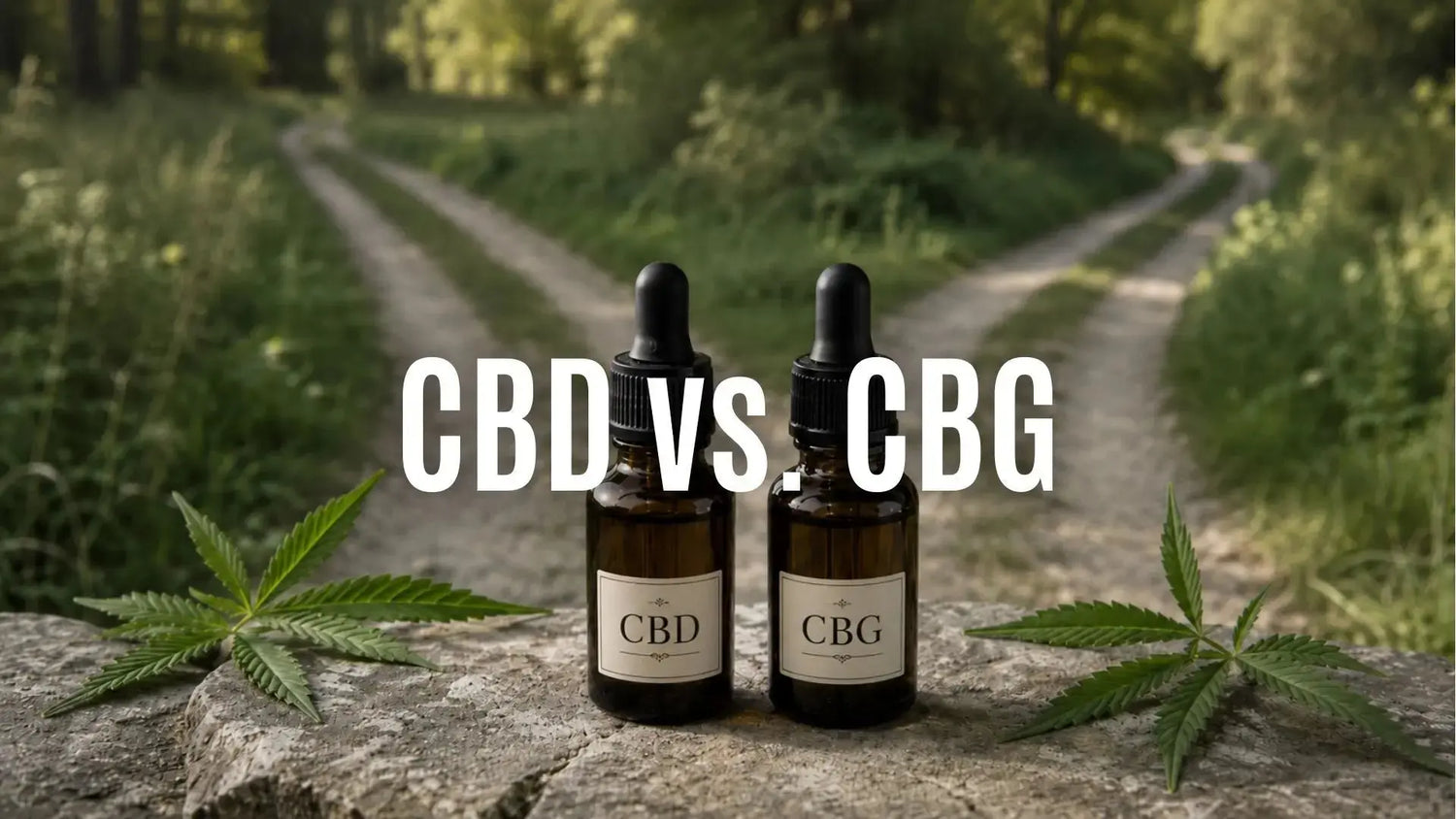

CBD and CBG are two non-intoxicating cannabinoids from the hemp plant, but CBD is significantly better known and more researched, while CBG is rarer and scientifically still in its early stages. The most important difference is: CBD is currently the more established cannabinoid, while CBG is the more exciting research cannabinoid with less substantiated human data.
CBD stands for cannabidiol, CBG stands for cannabigerol. Both substances differ from THC because CBD and CBG typically do not cause the classic cannabis high. However, the specific product is always crucial: residual THC, product category, laboratory analysis, and legal classification determine whether a hemp product is safe and marketable.
Contents
- What is CBD?
- What is CBG?
- CBD vs. CBG: The Most Important Difference
- How Do CBD and CBG Work in the Body?
- Is CBG Stronger Than CBD?
-
CBD or CBG: Which is Better for You?
- Is CBD Legal in Germany?
- Is CBG Legal in Germany?
-
What Does the Cannabis Act Mean for CBD and CBG?
-
Conclusion: CBD is More Established, CBG is More Interesting for Explorers

What is CBD?
CBD is a cannabinoid from Cannabis sativa L. and is one of the most well-known non-intoxicating hemp ingredients. CBD is significantly better studied scientifically than CBG, because CBD is already used in approved medicines. The EU-approved drug Epidyolex contains cannabidiol and is used for certain rare forms of epilepsy; the EMA mentions Lennox-Gastaut syndrome, Dravet syndrome, and tuberous sclerosis as areas of application under medical supervision.
For consumer products, this does not automatically mean that every CBD oil has a medicinal effect. Pharmaceutical CBD and over-the-counter CBD products are legally and qualitatively different categories. Precisely for this reason, CBD products should not be advertised with health claims.


What is CBG?
CBG is cannabigerol and is often referred to as the "mother cannabinoid" because the acidic precursor CBGA is a starting point for other cannabinoids such as CBD, THC, and CBC. In the plant, CBG is often present only in smaller quantities, because some of the cannabinoid precursors are converted into other cannabinoids during plant development.
CBG is interesting for many users because it is rarer and is specifically highlighted in modern hemp products. At the same time, the research data on CBG is significantly thinner than for CBD. Those comparing CBG products should therefore pay particular attention to laboratory analyses, transparent cannabinoid values, and realistic manufacturer information.

CBD vs. CBG: The Most Important Difference
The most important difference between CBD and CBG lies in the research data and availability. CBD is more established, more widely available, and better clinically studied. CBG is rarer, more expensive to produce, and has significantly less human study support to date.
|
Comparison Point |
CBD |
CBG |
|
Full Name |
Cannabidiol |
Cannabigerol |
|
Recognition |
Very high |
Growing, but smaller |
|
Occurrence in Products |
Frequent |
Rarer |
|
Research Status |
Significantly stronger |
Still limited |
|
Typical Role |
Established Cannabinoid |
“Minor Cannabinoid” / Research Cannabinoid |
|
Intoxicating like THC? |
No, CBD is not THC |
No, CBG is not THC |
|
Most Important Purchase Point |
Quality, THC level, product category |
Quality, CBG content, laboratory analysis |

How Do CBD and CBG Work in the Body?
CBD and CBG interact with endogenous signaling pathways, but both cannabinoids should not be presented as a sure treatment for ailments. Scientific research is investigating various possible effects, but many results come from laboratory, animal, or early human studies. For CBD, there are individual approved medicinal applications; for CBG, there is no comparably established medical approval yet.
Regarding CBG, a human study published in 2024 is particularly interesting: In a double-blind, placebo-controlled crossover study with 34 healthy adults, 20 mg of hemp-based CBG was tested. The study found temporarily lower anxiety and stress levels compared to placebo, and no evidence of subjective intoxicating effects or impairment; at the same time, the study was small and examined healthy adults, not patient groups.
The practical conclusion: CBD currently has a stronger evidence base; CBG is scientifically exciting, but not yet as well-substantiated.
Is CBG Stronger Than CBD?
CBG is not automatically “stronger” than CBD. CBG is different, rarer, and less researched. Statements like “CBG works better than CBD” are too sweeping and not scientifically well-proven.
A better comparison is: CBD is the more conservative choice for users looking for a known cannabinoid. CBG is more interesting for users who want to try a rarer cannabinoid and are willing to accept the weaker research data. For both, product quality is more important than marketing.
CBD or CBG: Which is Better for You?
CBD is a better fit if you are looking for a cannabinoid that is widespread, readily available, and better studied. CBG is a better fit if you are specifically interested in rarer cannabinoids and can find a product with transparent lab analysis.
CBD may be the better choice if:
- you are looking for a well-known hemp product,
- you value broader research,
- you are a beginner,
- you want to compare products more easily.
CBG may be the better choice if:
- you already have experience with CBD products,
- you want to learn about a rarer cannabinoid,
- you are looking for a product with a clearly stated CBG content,
- you pay particular attention to batch lab analyses.


Is CBD Legal in Germany?
CBD is not simply "legal" or "illegal" across the board in Germany; its classification depends on the specific product. Key factors include THC content, product category, marketing, composition, and whether the product is classified as a food, food supplement, cosmetic, or medicine.
For CBD as a food, the novel food question is central. The EFSA states that the European Commission considers CBD a novel food, provided the requirements of EU novel food law are met. In February 2026, the EFSA set a provisional safe level of 0.0275 mg per kg body weight per day for certain CBD food supplement formulations, which is approximately 2 mg of CBD per day for a 70 kg adult.
This EFSA limit does not apply to all people or all products. The EFSA explicitly refers to the provisional safe limit for food supplement formulations with at least 98% pure CBD, without nanoparticles and with a manufacturing process deemed safe; for individuals under 25, pregnant or breastfeeding women, and people taking medication, the EFSA does not consider the safety of CBD to be proven.

Is CBG Legal in Germany?
CBG must also be evaluated on a product-specific basis in Germany. CBG is not THC, but CBG products can be classified differently depending on manufacturing, residual THC, product form, and marketing. Therefore, different requirements apply to CBG oils, CBG flowers, CBG cosmetics, or ingestible CBG products.
For online retail, it is important: A product containing CBG should not automatically be advertised as a food or food supplement if its legal classification has not been checked. Health claims, unclear dosage recommendations, and missing THC/CBG lab values are particularly risky.
What Does the Cannabis Act Mean for CBD and CBG?
The German Cannabis Act has changed the handling of cannabis since 2024, but the partial legalization of recreational cannabis does not automatically mean that every CBD or CBG product is freely available. The Cannabis Act has been in effect since April 1, 2024, and primarily regulates possession, personal cultivation, and cultivation associations for adults; product law, food law, pharmaceutical law, and novel food law remain crucial for CBD/CBG products.
Therefore, the most important rule for a shop is: Don't just look at "under 0.2% THC." In addition, the product category, intended use, labeling, advertising, novel food status, and laboratory analyses must be checked..
Conclusion: CBD is more established, CBG is more interesting for explorers
CBD and CBG differ mainly in availability, research, and practical classification. CBD is the better-known and better-studied cannabinoid. CBG is rarer, is becoming increasingly popular for good reason, but is not yet as solidly substantiated scientifically as CBD.
Anyone looking to buy CBD or CBG should not look for the strongest marketing promise, but for the most transparent product: clear milligram indications, current analysis certificate, verified THC value, realistic description, and no health claims.
In short: CBD is the more established choice. CBG is the more exciting addition for anyone who wants to delve deeper into cannabinoids.