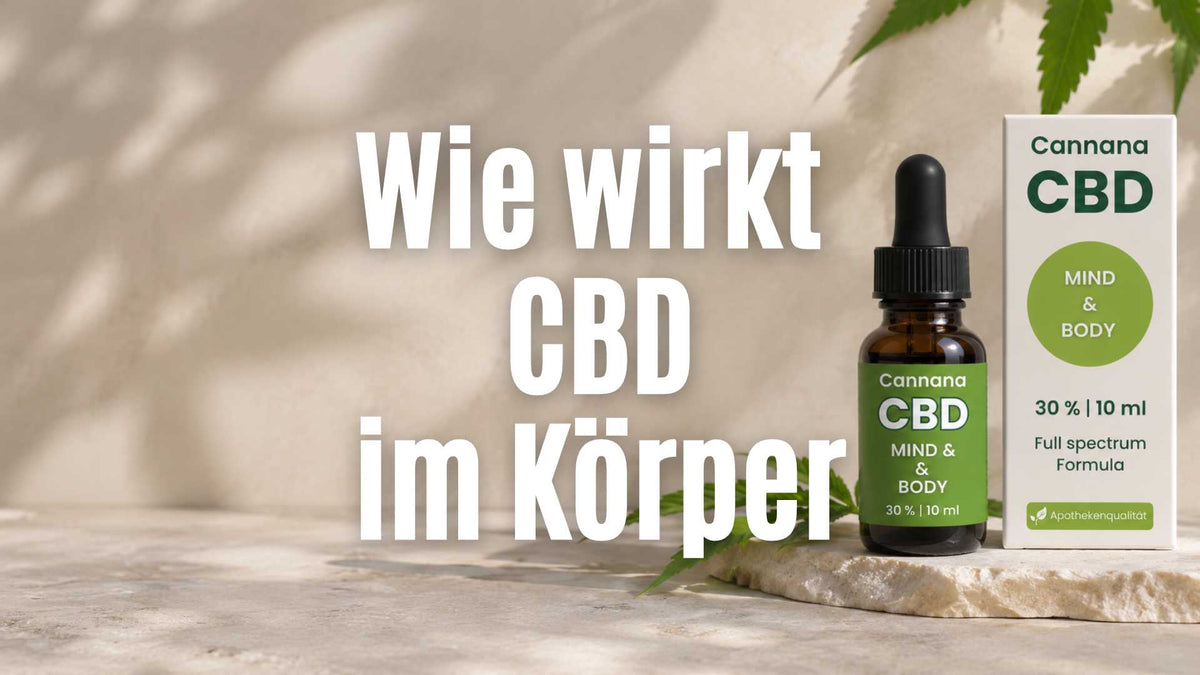

What is CBD oil and how does it work in the body?
CBD oil is a plant oil containing dissolved cannabidiol (CBD) from hemp. According to the German Federal Institute for Risk Assessment (BfR), the active ingredient binds only very weakly to cannabinoid receptors and does not have psychoactive effects like THC. CBD works partly indirectly via the endocannabinoid system and through other receptors.
The products are neither medicinal products within the meaning of Section 2 of the German Medicines Act nor medical devices within the meaning of Regulation (EU) 2017/745, and are not intended for the diagnosis, treatment, cure, or prevention of diseases.
At CANNANA, CBD oil comes from certified EU industrial hemp. According to Section 1 No. 9 of the German CanH Act, industrial hemp includes, among other things, hemp with a maximum THC content of 0.3% that is used solely for industrial or scientific purposes. In contrast, hemp oil from hemp seeds is a culinary oil.
The endocannabinoid system as the key to its effects
The endocannabinoid system (ECS) is an endogenous signaling network with receptors such as CB1 and CB2. It is involved in many processes; animal studies, for example, show that it plays a role in pain signaling. The CANNANA team recommends thinking of the ECS as the body's own regulator.
Cannabidiol does not directly activate the cannabinoid receptor 1. According to a 2023 review, CBD acts on the CB1 receptor, among other things, as a negative allosteric modulator. Simply put: CBD changes how strongly the receptor reacts to other signals.

CBD oil's effect on the mind: stress, anxiety, and mood
The evidence base for CBD and anxiety is limited and inconsistent. A 2024 meta-analysis evaluated 8 studies with 316 participants and found a significant effect (Hedges' g effect size = -0.92). However, the 95% confidence interval ranges from -1.80 to -0.04, and the authors urge caution due to the small sample size.
A 2024 systematic review of 11 randomized studies from 2013 to 2023 found often contradictory results. The data suggest a possible reduction in anxiety with few side effects. However, this does not prove that CBD is suitable as an anxiolytic (anxiety-relieving) agent. Over-the-counter CBD oil is not an approved psychopharmaceutical and does not replace psychiatric treatment.
Full-spectrum, broad-spectrum, or isolate: What role does the entourage effect play?
A 2024 US study defines three types of CBD oils as follows:
| Product type | Other cannabinoids | THC content | Terpenes/flavonoids |
|---|---|---|---|
| Full-spectrum | at least one other | Traces, max. 0.3% (US limit) | Other plant compounds |
| Broad-spectrum | at least one other | By definition, without THC | Not defined |
| Isolate | Not defined (over 95% CBD) | Not defined | Not defined |
The entourage effect is the hypothesis that cannabinoids and terpenes enhance each other's effects. According to a 2024 review, it remains unproven; a 2020 laboratory study found no such effect of terpenoids on cannabinoid receptors.
Another cannabinoid is cannabigerol (CBG), which the BfR has measured in CBD oils. Details can be found in the guide to Full-spectrum CBD vs. CBD Isolate.


How quickly does CBD oil work and how long do its effects last?
There is no fixed time until CBD oil takes effect, and reliable clinical guidelines are lacking. According to a 2025 study, a high-fat meal significantly alters the absorption of cannabidiol. It also determines how much CBD enters the bloodstream and thus reaches targets such as the endocannabinoid system.
When does CBD oil take effect? Factors influencing the onset of action
When CBD oil takes effect depends on how quickly cannabidiol enters the bloodstream and reaches the endocannabinoid system. In a study in Scientific Reports involving 11 healthy adults, CBD from capsules reached its peak level in the blood after around 5 hours when taken on an empty stomach. After a high-fat meal, it took 10 hours. When an effect becomes noticeable was not measured.
Absorption is influenced by:
- Meal: High-fat food increased the maximum CBD concentration by 17.4 times.
- Method of intake: Most CBD is swallowed, even when taken as drops under the tongue.
- Product: CBD dissolves poorly in water, which limits absorption.
- Person: After eating, blood levels fluctuated significantly between participants.
CBD duration of action: How long do its effects last?
How long CBD oil works cannot currently be stated in hours. A half-life could not be determined in the 2025 study due to double blood peaks. After eating, the blood peak occurred at 10 hours instead of 5.
| Method of intake | Peak blood concentration (Tmax) | Duration of action |
|---|---|---|
| Sublingual oil | varies* | varies* |
| Capsules | 5 h on an empty stomach, 10 h after a meal | varies* |
| Topical | varies* | varies* |
*depending on the product and person
CBD oil application and effects: The right way to take it for optimal results
It is customary to put CBD oil drops under the tongue and then swallow. According to a 2025 study, how much of the cannabinoids contained therein enters the bloodstream depends heavily on the meal. The CANNANA team explains the right way to take it in the Düsseldorf store and via WhatsApp, honestly and without technical jargon.
Taking CBD oil step by step: How do you take CBD oil?
The CANNANA team recommends the following four steps for getting started:
- Shake the bottle and read the manufacturer's instructions on the number of drops.
- Put the drops under the tongue with the dropper.
- Hold the oil under the tongue briefly.
- Then swallow the oil.
There is no scientifically proven holding time under the tongue. According to a 2025 study, most of the CBD is swallowed anyway. In that study, a high-fat meal increased the total absorption by 9.7 times.

Swallow or spit out CBD oil? The sublingual method explained
CBD oil is swallowed after a short time under the tongue, not spat out. Only a small amount of cannabidiol enters the bloodstream through the oral mucosa from standard oils. A 2025 study refers to Johnson et al. (2023), who found negligible sublingual absorption.
From a pharmacological perspective, the absorption of CBD through the oral mucosa has not been conclusively clarified. A 2023 review describes the route under the tongue as a possible bypass of the liver. The evidence base on this remains contradictory.
Taking CBD drops: How to determine the right dosage
For CBD oil, the principle "start low, go slow" applies: start with a few drops and gradually increase. According to a 2022 review, concrete dosage recommendations for sleep are not possible due to inconsistent studies. A dosage diary helps to keep track of the number of drops and your experience.
The European Food Safety Authority (EFSA) stated on February 9, 2026 that 0.0275 mg of CBD per kg of body weight per day was provisionally considered a safe level. This corresponds to around 2 mg for a 70 kg person and applies to supplements containing at least 98% pure CBD. According to the BVL, it still lacks approval as a food.
If you have questions about dosage, the CANNANA team is available for personal advice, online or in the Düsseldorf store.
Vaporizing CBD oil: Why experts advise against this method
The CANNANA team expressly advises against vaporizing or inhaling CBD oil. In a study on mice and human cells, CBD aerosol caused stronger inflammatory reactions and lung damage than nicotine aerosol. In bronchial tissue in the laboratory, aerosol from CBD-containing oil significantly increased the number of dead cells after 3 days. These findings come from animal experiments and laboratory studies.
Areas of effect of CBD drops: For which complaints is CBD used?
CBD oil is primarily investigated in three areas. These are areas of consumer interest and research, not medical applications:
- Pain and inflammation: A 2024 review assesses the clinical evidence as limited.
- Sleep and relaxation: A 2022 review of cannabinoids (THC and CBD) found improvements in 7 out of 19 randomized studies.
- Stress and anxiety: A 2024 meta-analysis of 8 studies urges cautious interpretation.
CBD for pain and inflammation
For pain and inflammation, research describes several possible points of action for cannabidiol in the endocannabinoid system and beyond. A 2024 systematic review mentions, among others, pain and serotonin receptors (TRPV1, 5-HT1A), the FAAH enzyme (breaks down endogenous cannabinoids), and immune cells in the nervous system (microglia). According to the authors, the clinical evidence is limited.
Another 2024 review describes the pain-related effect of CBD as complex and not yet sufficiently researched. CBD oil does not replace pain therapy, especially for chronic pain.
CBD for sleep disorders and exhaustion
It has not been proven whether CBD oil improves sleep. A 2022 systematic review of 31 studies on cannabinoids found improvements in 7 out of 19 randomized studies. Sleep architecture did not improve in measurements, and side effects such as sedation occurred mainly at higher doses.
CBD oil is not a sleeping pill. More on the time of intake and the limits of CBD drops in the evening can be found in the guide to CBD sleep drops.
Can you take CBD oil long-term? Safety, side effects, and interactions
The long-term safety of CBD oil has not been conclusively clarified. As early as 2022, the EFSA criticized insufficient data on the liver, gastrointestinal tract, hormone and nervous systems, and psyche. The BfR also sees no sufficient scientific evidence for the effects of CBD in food. For honest advice, therefore: anyone who wants to take the oil regularly should seek medical advice beforehand.
Overview of possible side effects
Side effects of CBD oil are known mainly from studies with high doses, such as with the medicinal product Epidyolex. The EFSA still considers the data on the liver to be incomplete.
- Liver values: According to JAMA Internal Medicine 2025, they rose sharply at 5 mg/kg daily in 8 people (5.6%) in the CBD group.
- Drowsiness: At 10 or 20 mg/kg daily, it affected 23% or 25%, respectively; for road safety, see Driving after CBD (THC limit in blood serum: 3.5 ng/ml).
- Fatigue: At the same doses, it affected 11% or 12%.
- Diarrhea: At the same doses, it occurred in 9% or 20%, compared to 9% in the placebo group.
Pay attention to interactions with medications
Cannabidiol is broken down by liver enzymes such as CYP3A4 and CYP2C19 and can interact with medicines (2019 review). Those affected are:
- Blood thinners such as warfarin and clopidogrel (metabolized via CYP2C19)
- CYP3A4 inducers such as the epilepsy medication carbamazepine and rifampicin, which lower the CBD level
- CYP3A4 inhibitors such as ketoconazole and protease inhibitors (e.g., HIV medications), which increase it
Interactions of CBD with antidepressants, opioids, and alcohol are described in a 2021 review. The CANNANA team recommends talking to a doctor or pharmacist when taking medication, also to watch out for side effects.
CBD oil and the legal situation in Germany: What the regulation reveals about the effect
According to the BVL, CBD-containing foods without novel food approval are not marketable (as of April 2025). Whether a CBD product is considered a medicinal product is checked by authorities on a case-by-case basis. At CANNANA: no gray areas, no questionable products.
Warning signs for a questionable product:
- A laboratory report on cannabinoids and THC is missing.
- The label promises a healing effect.
- An aroma oil also carries a dosage recommendation.
- Information on the origin of the hemp is missing.
Approved CBD medicine vs. over-the-counter CBD oils
Epidyolex is an approved medicine with cannabidiol; over-the-counter CBD oils are not approved medicines:
| Product type | Legal status | Approval |
|---|---|---|
| Epidyolex | Medicinal product | Seizures in Lennox-Gastaut syndrome, Dravet syndrome (with clobazam), and tuberous sclerosis, from 2 years |
| Over-the-counter CBD oil | Not an approved medicine | No novel food approval (as of April 2025) |
Studies on Epidyolex cannot be generalized to over-the-counter CBD oils. The German Federal Joint Committee (G-BA) assessed its benefit in Lennox-Gastaut syndrome for the first time on April 2, 2020, and most recently on May 16, 2024. CANNANA stands for honest communication, even when it is uncomfortable.
Novel Food Status: Why CBD Oil Is Legally in a Gray Area
A novel food is a food that was not consumed in significant quantities in the EU before May 15, 1997. According to the German Federal Office of Consumer Protection and Food Safety, CBD is classified as such, but it lacks approval (as of April 2025). According to its own statement, the EFSA is currently reviewing individual novel food applications based on its provisional value from February 2026.
The Chemical and Veterinary Investigation Office (CVUA) Karlsruhe found all 72 CBD products tested in 2023 and 2024 to be non-compliant, with 46 of them (64%) classified as harmful to health. The Higher Regional Court of Baden-Württemberg (August 16, 2023) and the Regional Court of Düsseldorf ruled that relabeling them as, for example, oral drops or cosmetic oral sprays was an attempt to circumvent the law. CANNANA oils are made from certified EU industrial hemp.
THC Content and Legal Limits: Is CBD Oil Really THC-Free?
Depending on the product, CBD oil may contain THC, the psychoactive substance found in the hemp plant. According to Section 1, No. 9 of the KCanG, industrial hemp is defined as hemp containing no more than 0.3% THC for commercial purposes, among other criteria. According to the BfR statement "Cannabinoids in CBD Oils" from 2024, 20 out of 26 oils contained THC, with levels ranging from 5 to 1,576 mg per kg.
According to the BfR, the EFSA's acute reference dose for THC is 1 µg per kg of body weight. According to the BfR, positive drug tests are possible, but are more likely below this reference dose (CBD and drug tests).
Recognizing Quality: What Experts Look for When Buying CBD Oil
Good CBD oil is identified by verifiable laboratory data, not promises. A 2024 US study found that 74% of 202 products had CBD deviations of at least 10%. According to CANNANA, all oils in the range are laboratory tested.
| Quality Feature | Why It Is Important | What to Look For |
|---|---|---|
| Laboratory analysis | 74% with deviations | current report from an independent laboratory |
| THC content | BfR: THC in 20 out of 26 oils | THC level in the laboratory report |
| Contaminants | Pesticides in 30, heavy metals in 44 products | Testing for pesticides and heavy metals |
| Origin of the hemp | Industrial hemp: no more than 0.3% THC, among other criteria | clear statement of origin |
Conclusion – The Expert Assessment of CBD Oil's Effects
As of today, CBD oil partly works indirectly via the endocannabinoid system, but there is no compelling evidence for specific effects. The EFSA has set since February 2026 a provisional safe level of around 2 mg of CBD per day for a 70 kg person, but only for at least 98% pure CBD and not for those under 25. According to the BVL, CBD-containing foods without novel food approval are not permitted for sale.
The CANNANA team provides honest advice on products, quality, and usage without technical jargon. Advice is available in the store at Flinger Straße 14 in Düsseldorf and via WhatsApp, while CANNANA CBD Oil provides an overview of the oils.
Frequently Asked Questions
What does CBD oil really do?
What CBD oil really does is still scientifically unclear. Small studies on anxiety and sleep provide inconsistent results, with cannabinoids showing sleep improvements in 7 out of 19 randomized studies. As a medicine, CBD is approved in products such as Epidyolex for certain seizure disorders, but over-the-counter oils are not approved.
When does CBD oil start to work?
There is no fixed time until CBD oil takes effect. In a 2025 study, CBD from capsules reached its highest blood concentration after around 5 hours when taken on an empty stomach. After a high-fat meal, the level was at 10 hours, but no noticeable effect was measured.
What possible side effects and interactions does CBD oil have?
In studies, high doses of CBD oil primarily caused drowsiness, fatigue, and diarrhea. In JAMA Internal Medicine 2025, liver values rose sharply in 5.6% of the CBD group at 5 mg/kg daily. CBD can also affect the metabolism of medications such as Warfarin, so consult a doctor or pharmacist beforehand.
Is CBD oil legal in Germany?
According to the BVL, CBD oil as a food is not permitted for sale in Germany because it lacks novel food approval (as of April 2025). Industrial hemp is defined in Section 1 of the KCanG, among other criteria, as containing no more than 0.3% THC and being intended for commercial purposes. CBD medicines such as Epidyolex are separately approved and, according to the EMA, require a prescription.
Does CBD oil contain psychoactive THC?
Depending on the product, CBD oil may contain THC, but cannabidiol itself is not psychoactive. The BfR found THC in 20 out of 26 tested oils, with levels ranging from 5 to 1,576 mg per kg of oil. The THC level in the current laboratory report for the respective product is decisive for assessment.
How do you dose and use CBD oil correctly?
It is customary to start cautiously with CBD oil: place a few drops under the tongue, hold them there briefly, swallow, and gradually increase the dose. The EFSA has provisionally set around 2 mg of CBD per day as a safe level for a 70 kg person, but only for at least 98% pure CBD and for those aged 25 and over. If you have pre-existing medical conditions or take medication, seek medical advice beforehand.
Who should not take CBD oil?
According to the EFSA, the safety of CBD for people under 25, pregnant or breastfeeding women, and people taking medication cannot be established (February 2026). Caution is advised with liver disease, as a 2025 study showed elevated liver values. CBD oil is intended only for adults; if in doubt, consult a doctor beforehand.
Are there quality differences in CBD oils, and how can you recognize good quality?
Yes, there are major quality differences in CBD oils. In a 2024 US study, the CBD content deviated by at least 10% in 74% of 202 products. 26% did not meet the stated product type, so current laboratory reports on cannabinoids, THC, and contaminants, as well as clear statements of origin, are therefore meaningful.
What is CBD oil good for?
CBD oil is frequently used for relaxation, sleep, and stress, but the evidence is limited. A 2022 review on cannabinoids (THC and CBD) found sleep improvements in 7 out of 19 randomized studies. These are areas of consumer interest, not medical applications for treating diseases.
How does CBD work in the body?
As of today, CBD partly works indirectly and, according to the BfR, binds only very weakly to cannabinoid receptors. A 2023 review describes CBD at the CB1 receptor, among other things, as a negative allosteric modulator. Many findings on the role of the endocannabinoid system in pain signals come from animal and laboratory studies.
Should you swallow CBD oil immediately after taking it or keep it in your mouth?
CBD oil is usually held briefly under the tongue and then swallowed. According to a 2025 study, most of the CBD enters the bloodstream via the gastrointestinal tract anyway. A study cited there found negligible absorption under the tongue, but manufacturer instructions also apply.
Sources and References
30
Scientific references, official statements, and legal frameworks for this article:
-
Konsumcannabisgesetz (KCanG) – § 1 Begriffsbestimmungen Law / Regulation
-
BfR: Cannabinoide in CBD-Ölen – wie viel ist enthalten? Official Authority
-
Straßenverkehrsgesetz (StVG) – § 24a 3,5 ng/ml THC-Grenzwert Law / Regulation
This article is provided for general informational purposes only and does not constitute legal, tax or medical advice. For individual questions, please consult a qualified professional. Laws and regulations may change – please always check the currently applicable legal requirements.