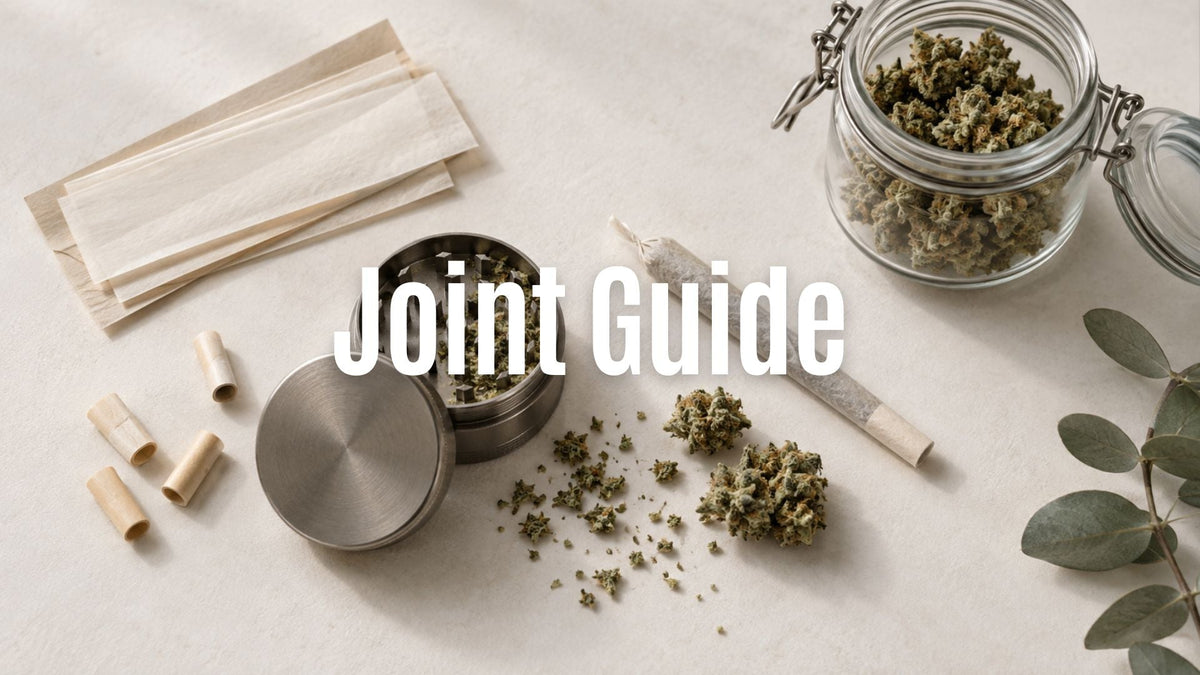

A joint consists of rolling paper, a filter tip, and ground cannabis. Rolling a joint properly is an essential fundamental skill for many cannabis consumers. How evenly a joint burns, how smooth the airflow feels, and how cleanly the flavor develops depends directly on preparation, paper choice, grind consistency, and rolling technique.
At the same time, practical questions arise: Which rolling papers are best? What is the difference between a paper tip and an activated carbon filter? How can canoe burns (sideburns) be prevented, and how should rolled joints be stored properly?
In this comprehensive Joint Guide, you will learn what equipment you need, a step-by-step tutorial for beginners, how to troubleshoot uneven burns, and what German legal regulations apply.
Table of Contents
- How Is a Joint Structured?
- What Accessories Do You Need to Roll a Joint?
- Which Rolling Papers Are Best for Joints?
- Paper Tips vs. Activated Carbon Filters: What Is the Difference?
- What Consistency Should the Cannabis Have?
- How to Roll a Joint: Step-by-Step Instructions
- How Much Cannabis Goes into a Joint?
- Why Does a Joint Burn Unevenly (Canoeing)?
- Common Mistakes When Rolling a Joint
- Rolling Your Own vs. Pre-Rolled Cones
- How to Store Rolled Joints Correctly
- Joints and the Legal Framework in Germany

How Is a Joint Structured?
A standard joint consists of three structural elements:
- Outer Wrapper: King Size slim rolling paper that encases the material and controls burn rate.
- Mouthpiece / Filter: A cardboard tip or activated carbon filter that stabilizes the base, keeps loose herbs out of your mouth, and cools the vapor.
- Filling: Evenly ground botanical material distributed uniformly throughout the cone.
What Accessories Do You Need to Roll a Joint?
To roll a clean, evenly burning joint, you need four basic tools:
- Quality Long Papers (King Size Slim).
- Filter Tips or Activated Carbon Filters.
- A 2-part or 4-part Herb Grinder for uniform particle size.
- A clean Rolling Tray to catch stray crumbs and provide a flat working surface.
Optional: A packing poker (wooden rod or unsharpened pencil) to gently pack the tip.
Which Rolling Papers Are Best for Joints?
Papers differ in material, thickness, and burn rate:
- Unbleached Wood Pulp: Classic feel, easy to roll, medium burn rate.
- Hemp Papers (Pure Hemp): 100% natural, highly tear-resistant, slow and steady burn, neutral flavor.
- Rice Papers: Ultra-thin, practically transparent, zero paper taste, burns exceptionally slow, but requires careful handling due to delicate moisture sensitivity.
For beginners, unbleached ultra-thin hemp or rice King Size Slim papers are generally the easiest to handle.


Filter, Tip, or Activated Carbon Filter: What Is the Difference?
The choice of filter significantly influences draw temperature and smoothness:
Cardboard Tips
Simple rolled paper cards that provide structural stability and airflow passage. They do not filter harmful combustion byproducts, but they allow unrestricted flavor transfer.
Activated Carbon Filters
Filled with granular coconut shell activated charcoal. They filter out a significant proportion of harmful tars and pollutants while cooling hot smoke, delivering a noticeably milder, smoother throat feel. Ceramic caps on both ends prevent heat transfer.
What Consistency Should the Cannabis Have?
Cannabis should be ground into a fluffy, medium-fine consistency.
If ground too coarse, air pockets form, causing rapid uneven burns and hot embers dropping off. If ground into fine powder, airflow becomes choked, making inhalation difficult. A standard two-piece or four-piece grinder achieves the ideal fluffy consistency.
How to Roll a Joint: Step-by-Step Instructions
1. Prepare Your Rolling Area
Place paper, filter, and grinder on a clean rolling tray.
2. Grind the Herb
Grind the dried flowers gently into uniform fluffy particles. Remove any thick woody stems that could puncture the paper.
3. Insert the Filter
Position the filter tip on your preferred side (left or right, depending on handedness) along the bottom crease of the paper, with the gum strip facing up and toward you.
4. Distribute the Material
Spread the ground material evenly along the trough. Place slightly less herb near the filter and slightly more toward the tip to naturally shape an ergonomic cone.
5. Form the Roll (The Tuck)
Using your thumbs and index fingers, gently roll the paper back and forth to shape the herb into a cylinder or cone. Gently tuck the lower edge of the paper around the herb and filter.
6. Roll and Seal
Once tucked, roll the paper upward, lightly moisten the gum line with your tongue, and seal it smoothly from filter to tip.
7. Pack and Close the Tip
Gently tap the joint upright on a hard surface to settle the herb. Use a poker to tamp down lightly (avoid over-compressing). Twist the open paper tip into a small wick to prevent loose crumbs from falling out.
How Much Cannabis Goes into a Joint?
A standard King Size Slim joint typically holds between 0.3 g and 0.7 g of ground herb, depending on paper length and cone diameter. Beginners should aim for smaller quantities and lower cannabinoid potency to remain comfortable.
Why Does a Joint Burn Unevenly (Canoeing)?
Canoeing (running) occurs when one side of the paper burns faster than the other, resulting in a hollow, spoon-like burn.
Primary causes include:
- Uneven density or air pockets in the paper
- Uneven lighting at the start
- Drafty wind during smoking
- Excessive moisture or dry spots in the herb
To fix canoeing: lightly apply moisture with a fingertip just below the fast-burning side to slow it down while touching a flame to the lagging edge.
Common Mistakes When Rolling a Joint
- Rolling too tight: restricts airflow completely, preventing smooth puffs.
- Rolling too loose: causes canoeing, fast burns, and falling embers.
- Leaving stems in the mix: stems pierce delicate rolling papers and burn harsh.
- Excessive saliva on the gum line: washes away the natural acacia gum, preventing the paper from adhering.
Rolling Your Own vs. Pre-Rolled Cones
Pre-rolled empty cones with integrated filters are pre-shaped paper cones that you simply fill and pack with a funnel. For individuals with limited motor dexterity or beginners seeking immediate results without learning to roll, pre-rolled cones offer a convenient, stress-free alternative.
How to Store Rolled Joints Correctly
Rolled joints dry out rapidly when exposed to open room air, which causes hot, harsh, and fast burns.
Store joints in an airtight, smell-proof “Doob Tube” (plastic or aluminum protective tube) or an airtight glass container. Keep them away from moisture and direct sunlight.

Joints and the Legal Framework in Germany
Under the German Cannabis Act (KCanG), adults in Germany are legally permitted to possess up to 25 grams of cannabis in public and up to 50 grams in their private residence.
However, public consumption is subject to strict statutory restrictions: Smoking cannabis is prohibited within 100 meters of schools, kindergartens, playgrounds, and public sports facilities, as well as in pedestrian zones between 7:00 AM and 8:00 PM. Consumption in the immediate presence of minors is strictly forbidden.
Sources and References
5
Scientific references, official statements, and legal frameworks for this article:
-
Konsumcannabisgesetz (KCanG) – § 1 Begriffsbestimmungen Law / Regulation
-
Konsumcannabisgesetz (KCanG) – § 3 Erlaubter Besitz von Cannabis Law / Regulation
-
Konsumcannabisgesetz (KCanG) – § 5 Konsumverbot und Schutzbereiche Law / Regulation
-
Konsumcannabisgesetz (KCanG) – § 6 Werbe- und Sponsoringverbot Law / Regulation
Frequently Asked Questions (FAQ)
What do you need to roll a joint?
Can you roll a joint without a filter?
Do you need a grinder to roll a joint?
This article is provided for general informational purposes only and does not constitute legal, tax or medical advice. For individual questions, please consult a qualified professional. Laws and regulations may change – please always check the currently applicable legal requirements.