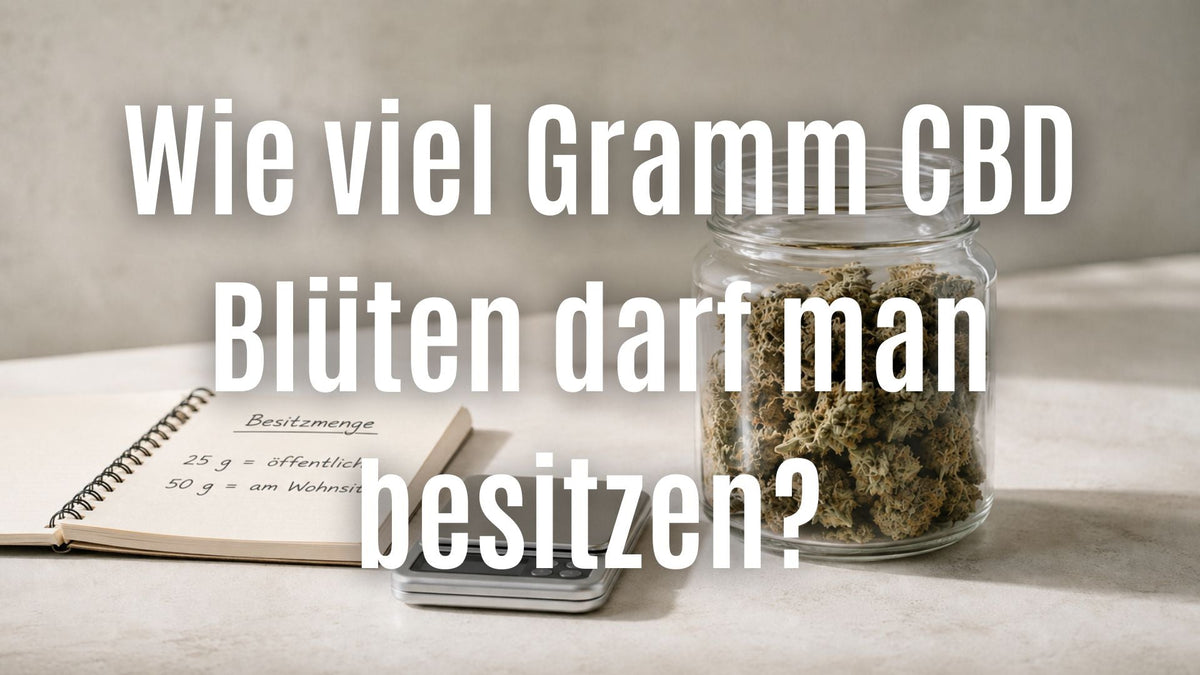

CBD flowers in Germany may not be assessed simply based on a general "CBD amount". The crucial factor is whether it is legally pure CBD, a CBD product, or cannabis plant material. For adults, the possession of cannabis under the Cannabis Consumption Act is permitted up to 25 grams in public spaces and up to 50 grams at their place of residence. The Federal Ministry of Health explicitly states these possession limits for dried cannabis.
Important: This article does not constitute legal advice. The legal situation for CBD flowers remains more sensitive than for CBD oil, CBD cosmetics, or CBD isolate, because CBD flowers are visually and botanically plant material of the cannabis plant.
Content
- How many grams of CBD flowers are allowed?
- Why CBD flowers are assessed differently than CBD oil
- When do 25 grams and 50 grams apply?
- What role does the THC content of 0.2% play?
- What happens with more than 25 or 50 grams?
- How should CBD flowers be transported safely?

How many grams of CBD flowers are allowed in Germany?
For CBD flowers, there is no separate, simple gram limit solely for CBD. If CBD flowers are classified as cannabis within the meaning of the KCanG, the general possession limits apply to adults: up to 25 grams outside the place of residence and up to 50 grams in total at the place of residence or habitual abode. The KCanG refers these quantities for flowers and flower-related plant parts to the weight after drying.
The practical recommendation is therefore: Anyone who possesses or transports CBD flowers should keep the quantity well below 25 grams in public spaces. At home, the total quantity per adult should remain clearly below 50 grams. This recommendation is particularly important because CBD flowers cannot be reliably distinguished from THC-rich cannabis flowers during a check.


Why CBD flowers are assessed differently than CBD oil
CBD as a single ingredient is not the same as CBD flowers. The KCanG defines cannabis as plants, flowers, plant parts and resin of the genus Cannabis, but excludes, among other things, CBD and industrial hemp from the definition of cannabis.
CBD oil, CBD cosmetics, or CBD isolate are therefore considered differently from loose flowers. CBD flowers remain plant material. This is precisely why the legal gray area arises: a product can contain a lot of CBD and little THC, but still look, smell, and be controlled like cannabis flowers. For consumers, therefore, not only the CBD content is important, but also origin, laboratory analysis, THC value, packaging, and the purpose of the product.
When do 25 grams in public and 50 grams at home apply?
The 25-gram limit applies to adults in public spaces. This means: Anyone carrying CBD flowers when out and about should not exceed 25 grams if the flowers are classified as cannabis plant material. The Federal Ministry of Health also explains that more than 25 grams up to 30 grams can constitute a minor offense.
The 50-gram limit applies at the place of residence or habitual abode. According to § 3 KCanG, the total amount of flowers, flower-related leaves or other plant material possessed must not exceed 50 grams based on dry weight.
For households with multiple adults, it is important: The limit is not automatically understood as a common household amount. Practically, each amount should be assignable to an adult. Those who store products together should therefore keep packaging and purchase receipts separately.

What role does the THC content of 0.2 % play?
The THC content of 0.2% is important for industrial hemp but not a simple "anything-goes" rule for every CBD flower. The BVL explains that the maximum content of 0.2% THC generally concerns the handling of industrial hemp and must not be misunderstood as a blanket maximum content for hemp-containing foods.
The KCanG describes industrial hemp, among other things, as plants, flowers and plant parts, if certain conditions are met: such as EU-certified seeds or a THC content of a maximum of 0.2%, as well as a trade that serves commercial or scientific purposes and excludes misuse for intoxicating purposes.
For CBD flowers, this means: a laboratory value below 0.2% THC is an important quality and safety feature. However, the laboratory value alone does not automatically guarantee that every CBD flower is legally unproblematic in every sales situation.
What happens with more than 25 or 50 grams of CBD flowers?
For quantities exceeding 25 grams outside the place of residence or 50 grams at home, legal issues may arise if CBD flowers are classified as cannabis. The KCanG stipulates that possession of more than 25 to 30 grams outside the place of residence or more than 50 to 60 grams in total may constitute a minor offense; the fine can be up to 30,000 euros in certain cases.
From more than 30 grams outside the place of residence or more than 60 grams in total, criminal liability may arise under § 34 KCanG. The legal penal provision provides for imprisonment of up to three years or a fine in such cases.
The clear recommendation for consumers is: do not push the limit. Those who buy CBD flowers should choose small quantities, keep the receipt, and not transport the product loosely in neutral bags.

How should CBD flowers be transported safely?
CBD flowers should ideally be transported in their original packaging in public spaces. The original packaging should clearly indicate the product name, batch, CBD content, THC information, and retailer. A laboratory analysis or a QR code for analysis can help with inquiries.
It is also advisable to: save the invoice, keep the quantity below 25 grams, and not leave CBD flowers openly in the car or in a bag. These points do not replace a legal review but reduce the risk of misunderstandings during controls.
CBD flower possession: practical overview
|
Situation |
Practical Orientation |
|
On the go / public space |
maximum 25 g, preferably significantly less |
|
At home |
maximum 50 g per adult, if classified as cannabis |
|
25–30 g on the go |
possible minor offense |
|
50–60 g in total |
possible minor offense |
|
More than 30 g on the go |
possible criminal liability |
|
More than 60 g in total |
possible criminal liability |
|
Industrial hemp with ≤0.2 % THC |
only less problematic if industrial hemp conditions are met |
Myths and facts about CBD flowers
Myth: CBD flowers are always permitted without limit.
Fact: CBD flowers can be relevant as cannabis plant material. For consumers, therefore, the KCanG quantities of 25 grams and 50 grams provide a safer frame of reference.
Myth: Below 0.2% THC, every CBD flower is automatically legal.
Fact: 0.2% THC is an important value for industrial hemp, but not the only prerequisite. Origin, purpose, product type, and exclusion of misuse also play a role.
Myth: CBD oil and CBD flowers are treated equally under the law.
Fact: CBD as an ingredient is exempt from the KCanG, but flowers are plant material and are therefore viewed more strictly.
Conclusion: CBD flowers should be planned according to cannabis quantities
Anyone who possesses CBD flowers should not rely on the statement "CBD is legal". For CBD flowers, the safer frame of reference is: a maximum of 25 grams when out and about and a maximum of 50 grams at home, provided the flowers are classified as cannabis plant material. In addition, CBD flowers should contain less than 0.2% THC, come from a traceable origin, and be documented with a laboratory analysis and proof of purchase.
Official sources on the legal status of CBD flowers