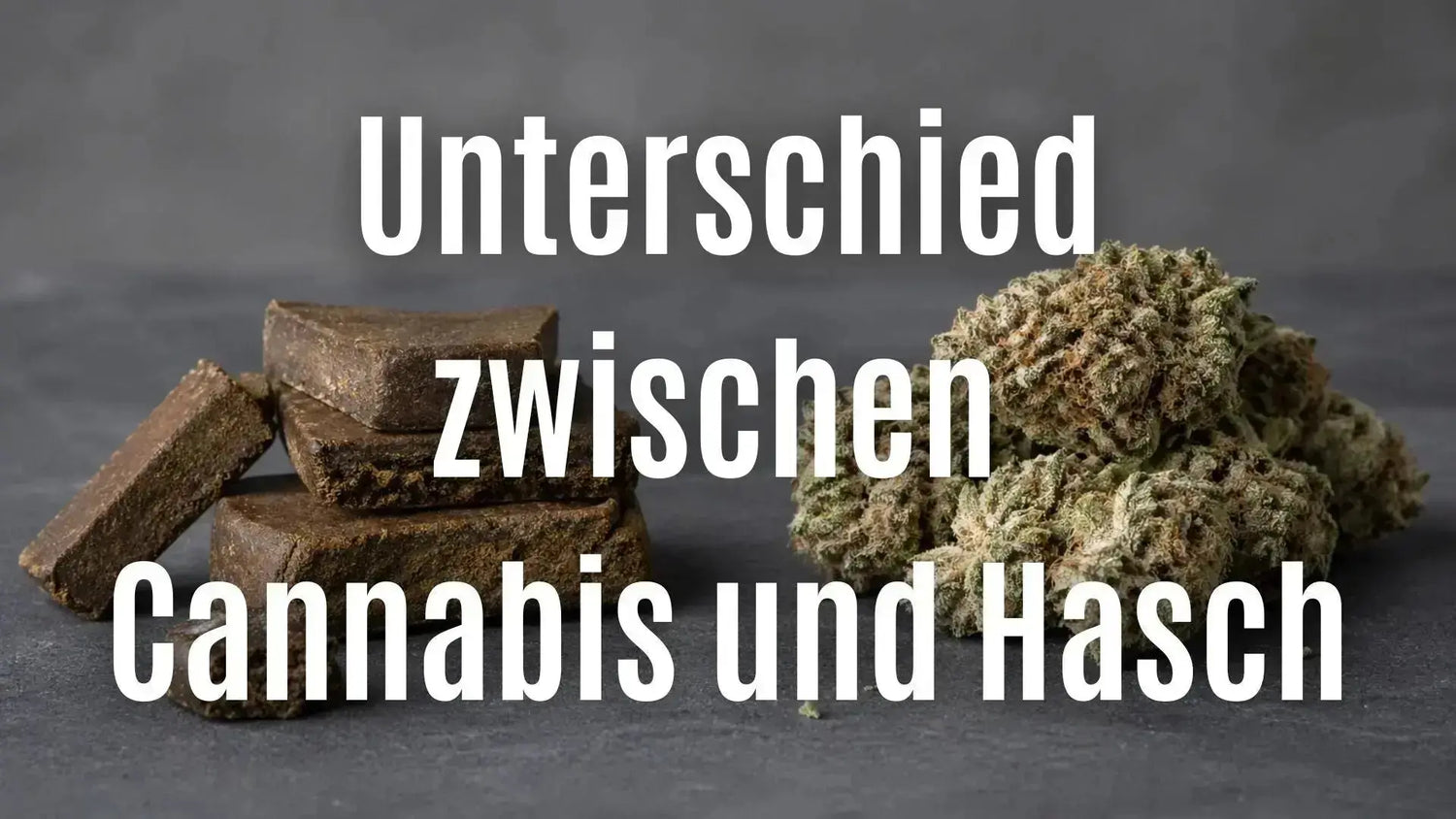

In everyday language, cannabis usually refers to the dried flowers of the hemp plant. Hashish, or hash for short, on the other hand, consists of the plant's resin, which is separated from the flowers and pressed. The most important difference, therefore, is not in the plant species, but in the processing: flower remains flower, hash is concentrated plant resin.
Both terms belong to the same botanical world. Nevertheless, cannabis flowers and hash differ significantly in appearance, consistency, aroma, storage, and traditional production. We explain these differences clearly here — without myths, without exaggeration, and with a focus on tested quality.
Legal Notice: The legal classification of cannabis, CBD, and hemp products in Germany depends on the product type, composition, intended use, and current legal situation. Official information can be found at the Federal Ministry of Health on the Cannabis Act, in the Cannabis for Consumption Act at Gesetze im Internet, and in the BMG-FAQs on the Cannabis Act. This article is not legal advice.
Cannabis and Hash in direct comparison
| Feature | Cannabis Flowers | Hashish / Hash |
|---|---|---|
| Origin | Dried flowers of the hemp plant | Pressed resin of the hemp plant |
| Processing | Natural, dried, mostly unpressed | Resin glands are separated and compacted |
| Consistency | Loose, herbaceous, structured | Solid, crumbly, soft or malleable |
| Aroma | Often fresh, floral, citrusy or herbaceous | Often earthy, spicy, warm or resinous |
| Appearance | Visible flower structure | Compact mass or slab |
| Quality recognizable by | Aroma, structure, residual moisture, cleanliness, laboratory analysis | Purity, consistency, aroma, processing, laboratory analysis |

The History of Hashish: Where the difference between cannabis and hash originates
To truly understand the difference between cannabis and hash, we need to delve deep into history. The cradle of hashish culture lies in Central Asia and the Middle East. It is believed that hashish became popular around the 10th century in Persia and the Arab world. According to legend, Sufi mystics used the concentrated form of the plant to enter spiritual states.
The invention of extraction
The idea behind hashish was as simple as it was ingenious: Since cannabis flowers are voluminous and dry out quickly, people sought a method to preserve the "essence" of the plant. They discovered that the sticky resin glands (trichomes) contain the highest density of active ingredients.
The actual protagonists in the difference between cannabis and hash are tiny: trichomes. Under a magnifying glass, they appear as glassy crystals on the surface of the flower. These resin glands contain cannabinoids, terpenes, and flavonoids – in other words, the groups of substances that shape the aroma, fragrance profile, and botanical character of the plant. Hashish is essentially nothing more than a condensation of precisely this resin structure.
- The "Saba" method: In early history, the resin was often rubbed from the hands after walking through flowering fields.
- The sieving technique: Later, in regions like present-day Iran and Turkey, the technique was developed to beat dried plants over fine cloths to collect the "kief" (the pure resin powder) and then press it.
Where is the best hash produced? Origin and terpenes
When experts discuss the difference between cannabis and hash, the word "origin" quickly comes up. Similar to wine, the terroir (soil, climate, altitude) determines the quality.
-
Morocco (The Rif Mountains): Morocco is considered the world's largest producer. The climate there is ideal for the sieving technique. Moroccan hash is known for its light, sandy color and spicy aroma.
-
Afghanistan (Hindu Kush): This is where the traditional production of black hashish originated. It is often pressed under heat and has a very dark, malleable consistency.
-
India & Nepal: Here you can find the legendary "Charas," which is obtained by rubbing the living plant. It is considered one of the most aromatic products worldwide.

Botany and Terpenes: How processing influences the aroma
It's a misconception to believe that the only difference between cannabis and hash lies in their form. It's primarily about the concentration of terpenes. In the flower, these essential oils are preserved in their freshest form. During hashish production, the resin glands are pressed, leading to slight oxidation. This gives the product its typical, heavy note.
Focus on CBD and quality
Since the THC value in Germany must not exceed the limit of 0.2%, the focus for our Superior Flowers is on a high CBD content. We distance ourselves from synthetic additives and rely on the natural power of the plant, as also observed by the Federal Office of Consumer Protection and Food Safety (BVL).


Myth vs. Fact: Cannabis and Hashish
| Myth | Fact |
|---|---|
| Hashish and cannabis are two different plants. | No. Both come from the same plant. The difference is not in the species, but in the processing: cannabis refers to the dried flower, hashish to the concentrated resin of the flower. |
| Hashish is always the same. | No. Color, consistency and aroma depend heavily on origin, strain, drying, storage and pressing. Therefore, hashish can be light, dark, firm, soft, spicy or earthy. |
| The difference between cannabis and hash is only in appearance. | Not quite. The visual difference is only part of it. The decisive factor is the concentration: hashish consists of compacted resin glands, while cannabis retains the natural flower structure. |
| Hashish simply smells stronger than cannabis. | Not always. The aroma changes through drying, pressing and oxidation. This often creates heavier, spicier and earthier notes, while flowers more often smell fresh, floral or herbaceous. |
| The darker hashish is, the better it is. | That's a misconception. Color alone says little about quality. Origin, purity, terpene profile, processing, and storage are decisive. |
| Cannabis flowers are always more natural than hashish. | Not necessarily. Hashish can also be produced purely mechanically — without synthetic additives. The difference lies in the fact that hashish concentrates the resin glands of the plant. |
Which form fits better?
Whether cannabis flowers or hash are better suited is primarily a matter of preference, aroma, and product category.
Flowers appeal to people who appreciate the natural structure of the plant. They appear fresh, visible, and strain-specific. Hash is more compact, traditional, and often aromatically denser. Both forms have their own culture and their own sensory quality.
When choosing, you should not only pay attention to appearance and scent, but also to transparency: origin, analysis, ingredients, and legal classification are more important than grand promises.
Conclusion: Choosing the right product
Anyone who understands the difference between cannabis and hash sees hemp products with different eyes: The flower represents the natural form of the plant—visible, fragrant, unprocessed. Hashish stands for concentration, tradition, and aromatic depth. The fascination of modern hemp culture lies precisely between these two poles: nature on one side, artisan-crafted essence on the other.
CANNANA, as a curated shop, offers you the best of both worlds. Our products are designed for people who value legality, safety, and a first-class aromatic profile.