
CBD itself is usually not the main target of classic cannabis drug tests. Many drug tests do not look for cannabidiol, but for THC or THC metabolites. Problems can still arise if a CBD product contains traces of THC, is mislabeled, or lacks a reliable laboratory analysis. This is precisely why buyers of CBD products should not only pay attention to the CBD content, aroma, or price, but also to the THC value, origin, and laboratory testing.
At CANNANA, CBD and CBG products from certified EU industrial hemp are the focus. CANNANA highlights lab-tested premium quality, natural terpene profiles, and sustainable cultivation as key quality features for its flowers. At the same time, CANNANA points out that the products offered are not intended for the diagnosis, treatment, cure, or prevention of diseases and may only be used within the framework of applicable legal provisions.
Contents
- CBD itself is usually not the target of a cannabis drug test
- THC traces are the real risk in CBD products
- Full-spectrum CBD has a higher drug test risk than THC-free products
- Urine test, saliva test, blood test, and hair test measure different things
- CBD and driving mainly depend on the THC value
- Laboratory analysis and batch testing reduce the risk
- Red flags in CBD purchasing increase the drug test risk
- CBD and drug test: CANNANA checklist before purchase
- Conclusion: CBD is not the main problem, THC traces are the risk

CBD itself is usually not the target of a cannabis drug test
CBD itself is normally not sought in classic cannabis drug tests. A cannabis drug test typically targets THC or THC metabolites because THC is the psychoactive component of the cannabis plant. CBD is a different cannabinoid and does not cause the same high as THC.
However, this does not mean that every CBD product is automatically risk-free. Depending on the manufacturing process, raw material, extract form, or product quality, a CBD product may contain small traces of THC. If a test detects THC or THC metabolites, the result can be problematic for the user, even if the user only purchased a CBD product.
CANNANA Recommendation: When it comes to CBD and drug tests, buyers should always distinguish between CBD as a cannabinoid and THC as a test risk. The decisive factor is not just "contains CBD," but also "how much THC is detectable?"


THC traces are the real risk in CBD products
THC traces are the most important risk factor for CBD products and drug tests. Many users ask, "Can CBD be positive?", but the more precise question is, "Can my CBD product contain enough THC to show up in a test?"
The risk increases if a product lacks a clear laboratory analysis, is sold as a full-spectrum product, or comes from an unclear source. In international studies, CBD products have repeatedly been described as mislabeled; a 2017 analysis of online-sold CBD products published in JAMA was widely reported because many products were not accurately labeled as advertised and sometimes contained THC.
CANNANA Recommendation: Anyone who needs to be particularly careful due to their profession, driver's license, MPU, police checks, or sports controls should not buy CBD products without clear THC information and laboratory testing.

Full-spectrum CBD has a higher drug test risk than THC-free products
Full-spectrum CBD carries a higher drug test risk than THC-free CBD products. Full-spectrum means that in addition to CBD, other natural hemp components may be present. Depending on the product, this may include very small traces of THC.
THC-free products, CBD isolates, or products with a clear "not detectable" statement in the lab report are generally the better choice for very cautious users. Nevertheless, no provider should guarantee that a drug test will never be positive, as testing procedures, cut-off values, consumption patterns, product quantities, and individual factors vary.

Urine test, saliva test, blood test, and hair test measure different things
Urine, saliva, blood, and hair tests answer different questions. A urine test often shows THC metabolites, a blood test is particularly relevant in road traffic, a saliva test is often used as a quick preliminary test, and a hair test can cover longer periods. Drug tests can have different detection windows depending on the material and the question being asked.
For CBD buyers, the most important thing is: A negative or positive test does not only depend on the product. The type of test, threshold, laboratory procedure, frequency of use, quantity, and time interval also play a role. Therefore, blanket statements like "CBD is always safe in a drug test" are not serious.
CANNANA Recommendation: Anyone who is regularly tested should seek medical or legal advice before using CBD products and only choose products with verifiable laboratory testing.

CBD and driving mainly depend on the THC value
CBD and driving become problematic primarily when THC is detected or driving ability is impaired. Since August 22, 2024, a THC limit of 3.5 nanograms per milliliter of blood serum applies in Germany for drivers. Stricter rules apply to novice drivers during their probationary period and drivers under 21 years of age.
This limit refers to THC, not CBD. Nevertheless, a CBD product with traces of THC can become problematic in the wrong context. Unclear products, mixed products, THC-containing products, or products with synthetic cannabinoids are particularly risky.
CANNANA Recommendation: Anyone who drives should not use products that could impair attention, reaction time, or legal safety. When in doubt: do not drive and seek professional advice.
Laboratory analysis and batch testing reduce the risk
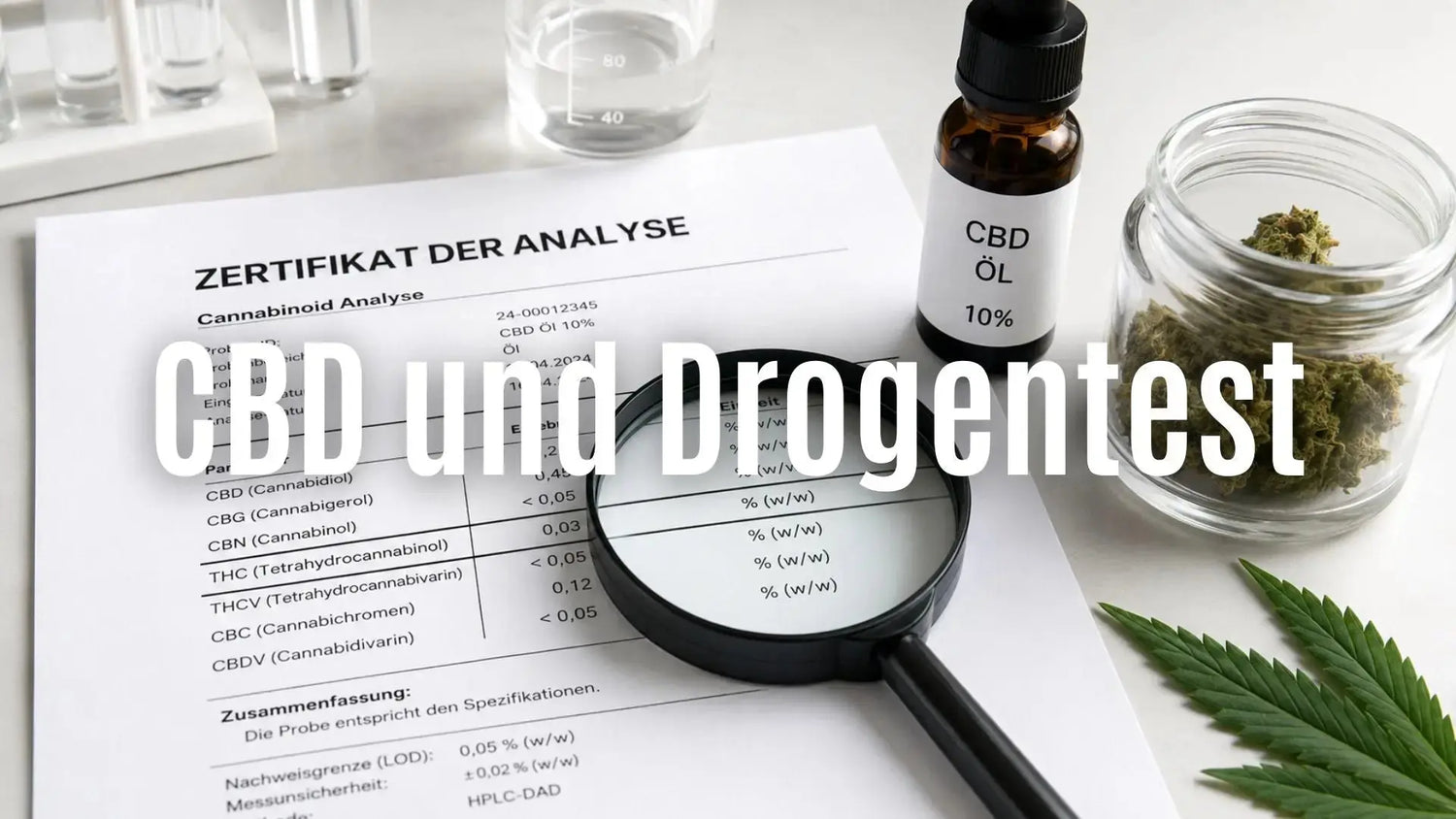
A laboratory analysis reduces the risk regarding CBD and drug tests because it makes the THC value traceable. Good lab reports show not only the CBD content but also relevant cannabinoids and THC levels. Even better is an analysis that matches the specific batch.
Without laboratory analysis, the buyer must blindly trust the label. This is precisely where the greatest risk arises. A product may be advertised as a CBD product but still contain more THC than expected. In drug tests, ultimately, it is not the advertising claim that matters, but what is actually detectable in the body.
CANNANA Recommendation: Before purchasing, check whether the provider is transparent about laboratory testing, origin, and THC value. A laboratory analysis is not a luxury but a central safety feature.

Red Flags in CBD Purchasing Increase the Drug Test Risk
Missing laboratory values are the most important warning sign when buying CBD. If a CBD shop does not state a THC value, batch testing, or a clear product type, the buyer can hardly assess the drug test risk.
Other red flags include unrealistic promises, unclear terms like "extra strong," "legal high," "THC alternative," "synthetically enhanced," or missing information about the origin. Products that simultaneously advertise CBD, THC-like cannabinoids, or new semi-synthetic cannabinoids are also problematic for cautious users.
CANNANA Recommendation: A reputable CBD shop explains quality, origin, and laboratory testing. An disreputable CBD shop relies on hype, strong promises, and unclear formulations.
CBD and Drug Test: CANNANA Checklist Before Purchase
Before purchasing a CBD product, you should check seven points:
- Is there a laboratory analysis?
- Is the THC value clearly stated?
- Does the laboratory analysis match the batch?
- Is the origin of the hemp traceable?
- Is the product CBD, CBG, CBC, full-spectrum, or isolate?
- Are there clear instructions on use and legal classification?
- Does the provider refrain from health claims and exaggerated promises of efficacy?
- If several points are missing, the drug test risk is difficult to assess. Anyone who depends on an inconspicuous test result professionally, legally, or privately should check particularly strictly.


Conclusion: CBD is not the main problem; THC traces are the risk
CBD itself is usually not the main problem in a drug test. The real risk arises from THC traces, mislabeled products, missing laboratory analyses, and unclear product quality. Therefore, CBD buyers should pay particular attention to the THC value, laboratory testing, origin, and product type.
Anyone who wants to safely assess CBD and drug tests should not believe blanket promises. The better strategy is: check the laboratory analysis, read the THC value, understand the product type, and remain cautious if uncertain. At CANNANA, certified EU industrial hemp, lab-tested quality, and transparent product information are central.